








The City of Charleston Office of Cultural Affairs presents Richard Hagerty: American Surrealist
November 4, 2015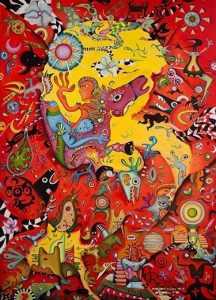
At the City Gallery at Waterfront Park
CHARLESTON, SC – The City of Charleston Office of Cultural Affairs presents Richard Hagerty: American Surrealist at the City Gallery at Waterfront Park November 20, 2015 through January 10, 2016, featuring paintings by the recently retired, highly-respected local physician. The exhibition, curated by Roberta Sokolitz, will open with a reception on Thursday, November 19 from 5 to 7 p.m. In addition, the public is invited on Sunday, December 13 and again on Sunday, January 10 at 2 p.m. to visit the exhibition with the artist in attendance, as Hagerty shares insights and answers questions in a pair of artist’s talks. All events are free and open to the public.
Richard Hagerty: American Surrealist is a major retrospective exhibition, presenting four decades of the artist’s paintings exploring mythology, astronomy, anatomy, botany, history, philosophy, and world religions. This self-taught, prolific artist paints from a vast reservoir of dreams – his store of personal imagery suffused with the infinite memories, symbols, and archetypes of the collective unconscious. Hagerty, a recently retired, highly-regarded local surgeon, observes, “The style of surrealism is a visual language that allows me — a southerner by birth who is also formally trained in the rigors and disciplines of science — to explore and express my obsessions with deep history, fascination with myth and symbol, and inexhaustible curiosity about color and form.”
Inspired by the boundless creativity of surrealism, Hagerty’s art portrays the essential experiences and mysteries of life, mixed-up. As a medical student studying psychoanalysis and art, he began to sketch his dreams in pencil, pen and watercolors, creating wild Freudian scenarios, juxtapositions of biomorphic figures and forms, and introducing his menagerie of recurring self-portraits and other human and animal creatures. During the 1980s and ‘90s, he refined his style, intensified color and explored larger and more complex scenes and narratives. Around 2000, he turned to oils to create larger compositions, with even bolder color, contrasts and visual impact.