







First Revolutionary War Bloodshed Launches Lander Community Lecture Series
October 6, 2025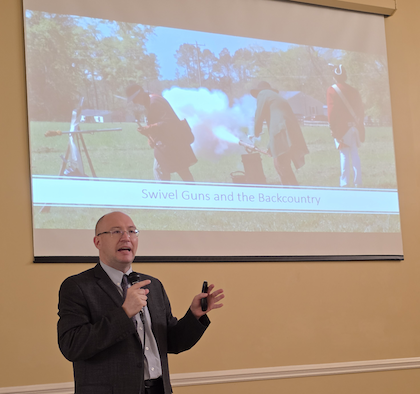
Lander University’s Community Lecture Series began its 2025-26 season with a program on the Siege of Savages’ Old Fields in Ninety Six, the first site of bloodshed in the South in the American Revolutionary War.
Led by Dr. Franklin Rausch, a Lander history professor and researcher on the American Revolution, the discussion centered on the battle, Nov. 19 – Nov. 22, 1775, that had many unusual characteristics, including the low number of deaths – only one British soldier and only one American, James Birmingham, the first South Carolinian to give his life in the cause for freedom.
“It was a dangerous situation involving a significant number of angry men with guns,” said Rausch, noting this was in sharp contrast to the events to come just five years later, when the Revolutionary War in South Carolina led to some of the bloodiest battles among all the colonies.
A Battle by Happenstance
Because the Declaration of Independence had not yet been written, many were reluctant to fight over their differences.
The sympathizers of King George III, known as the Loyalists, wanted to be left alone. And many who eventually sided with the Patriots weren’t prepared for a full-scale war. The battle “began more by chance than desire,” said Rausch.
The 1775 siege was in sharp contrast to the Siege of Ninety Six fought between May and June 1781 when an estimated 232 American and British soldiers lost their lives.
A full accounting of the battle and its significance in the Revolutionary War recently earned national recognition when Rausch’s article, “The Siege of Savages’ Old Fields: Halting Steps towards War,” was published in the Journal of the American Revolution. The article gives an in-depth look at the roleof this confrontation in the nation’s fight for liberty.
From Classroom to the Community
Rausch’s talk follows Lander’s recent Constitution Day program, “A Visit with John Adams and Thomas Jefferson: We Disagree as Rational Friends,” featuring historical actors, Peyton Dixon and Steven Edenbo.
Such community events, including the University’s extensive arts and music programs, underscore the integral role that universities play in their communities. “They are not and should not be isolated from the cities and people around them,” said Dr. Ryan Floyd, chair of the Department of History and Philosophy at Lander. “Greenwood is important to us at Lander, and I for one am grateful for how the community supports us.”
The University has much to offer Greenwood’s residents. “As a center for higher learning, Lander also has the ability to provide programing for the community through things like student and faculty musical performances, art exhibits and public lectures on a wide variety of talks from literature and history to science and technology,” Floyd said. “Many of our students graduate and remain in the surrounding area. They contribute to the economy, civic life and vibrancy of the community.”
The Community Lecture Series continues Tuesday, Oct. 28, with the program, “A Drunken History: The Story of America’s Love of Alcohol and the Drinks that Have Defined Us,” by Dr. Andrew Jameson.