







Presbyterian College faculty and students lead initiative to improve cancer literacy in rural communities
December 21, 2025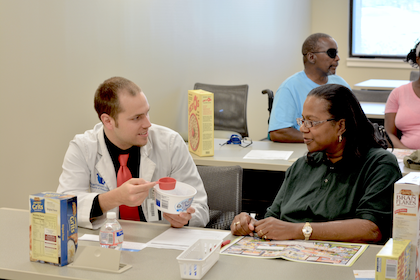
Interdisciplinary research, community outreach, and personal calling converge in a new study published by PC faculty and students.
A decade ago, Dr. Christopher Farrell stood in front of a small group gathered at First Baptist Church of Clinton and gave what he thought was a clear and engaging talk on breast cancer. He spoke about genetics, DNA, treatment pathways — a full academic lecture delivered earnestly to a room of older adults.
Their smiles encouraged him. Their feedback afterward changed everything.
“One of the women said, ‘Son, I have no idea what you were talking about, but you were so excited,’” Farrell said. “That’s when it hit me — we needed to find a completely different way to talk about cancer.”
What began as a humbling moment in a church fellowship hall has become a multi-year rural health initiative at Presbyterian College — culminating in a recently-published article in the Journal of Cancer Education. The study is co-authored by Farrell, now an adjunct professor in the PC School of Pharmacy; associate professor of biology Dr. Austin Shull ’11, and assistant professor of occupational therapy Dr. Courtney Addison. It also includes contributions from biology major Natalie Paxton, who brought her own background in rural breast cancer support to the project.
Together, their work shows how training pharmacy students through a “teach-the-teacher” model can significantly improve cancer literacy, empower rural patients, and strengthen the role of pharmacists in community health.
A Rural Problem With Real Consequences
The project is rooted in a sobering reality: rural Americans face worse outcomes for almost every major health condition, including cancer. Even when incidence rates are similar to those in urban regions, mortality rates are higher.
“Rurality really tracks for worse outcomes concerning cancer,” Shull said. “Diagnoses are about the same, maybe even a little less, but the survival is worse.”
Researchers point to a constellation of causes — limited access to specialists, fewer screening opportunities, transportation barriers, economic strain, and lower health literacy.
That last factor is the one Farrell set out to address.
“The community wanted this education,” he said. “They wanted someone to explain these diseases in a way they could understand, and pharmacists are often the health professionals they interact with most.”
A patient may see a pharmacist ten times more often than their primary care provider, Shull notes. That frequency creates natural opportunities for communication, trust-building, and guidance — all essential factors in early detection and improved outcomes.
“Pharmacists are on the front lines,” Farrell said. “People ask them questions all the time. They need to feel confident answering them.”
A Model Built for Connection
After his experience at First Baptist, Farrell began developing a model that would place pharmacy students at the center of community-based cancer education. The model had three simple components:
- Workshop-style training on cancer biology, risk factors, and communication strategies
- Student outreach to churches, community centers, and survivor groups
- Data collection and assessment to evaluate student confidence and knowledge gains
Students learned how to break down complex topics — staging, treatment options, genetic risk — into accessible language tailored to the people they were serving.
“It was a win-win for everybody,” Farrell said. “Students learned how to communicate, the community learned how to understand their diagnoses, and it reinforced the mission of PC.”
The response was immediate.
“I never had to recruit students,” Farrell said. “They gravitated toward it. It shows something about PC’s culture — students want to serve.”
That initial group – Melanie Ginzburg, Morgan Enlow, Marlana Roberts, Hilary Stamps, Cayla Adams, Missouri Jenkins, and Alexus Hamus – are all practicing pharmacists now, carrying the lessons they learned in the community into their current careers.
A Community Perspective: Meeting People Where They Are
When Addison joined the project, she brought not only help with data collection and analysis but also a broader community health perspective.
“The impact was in meeting the population where they were,” Addison said. “The students going to the churches was huge. It met the culture of the community.”
She emphasized that faith-based settings provided more than convenient locations — they offered emotional scaffolding for patients, survivors, and families navigating cancer.
“That’s not somewhere you typically see from a medical model,” she said. “But it was so impactful.”
Addison recalled one community member who learned something from a pharmacy student presentation, shared it with someone else, and helped that person seek an early diagnosis.
“That ripple effect was so much more important than a social media post or a flyer or a newspaper,” she said. “Meeting people where they’re at — that was the cool thing this whole project encompassed.”
Her perspective also reflects her passion for connecting occupational therapy to rural cancer survivorship. The OT program now partners with the Laurens County Cancer Association, offering monthly education sessions on diet, exercise, home modifications, fatigue management, and mental well-being.
“People here face disparities — transportation, access to care, all those things,” she said. “Strategies like this help increase survivorship rates and overall health.”
Scientific Roots, Educational Reach
For Shull, the project blended two sides of his career he rarely gets to combine.
“There’s the basic scientist part of me, trying to understand how cancer grows and spreads,” he said. “This project has been about the educator — how we can have larger impacts on long-term health outcomes.”
Shull said the pharmacy workshop produced measurable gains in students’ confidence and understanding, especially around modern therapies and diagnostic markers.
“We saw good gains in pharmacists and pharmacy students being trained in a rural population,” he said. “They were better able to communicate the nuances that have grown in cancer diagnoses, prognosis, and therapy.”
This educational success was only one piece of a much larger vision taking shape across campus.
Student Impact: A Calling Years in the Making
For Paxton, the research began long before she stepped onto campus or took her first PC class.
“My mom started a breast cancer organization after my grandmother was diagnosed,” Paxton said. “She saw the need for community and how everyone’s affected, not just the patient.”
The organization, United in Pink, serves rural families in Macon, Georgia — offering kids’ camps, support groups, financial assistance, and emotional care. Paxton grew up in that world, both as a camper and volunteer.
“It touched me,” she said. “It was personal, not just research. It started way before college.”
When Shull invited her to help with background research for the paper, she recognized a familiar landscape. Rural families in South Carolina faced many of the same challenges she had witnessed back home.
“Seeing rural breast cancer patients and what they go through firsthand — it solidified what I’ve seen, but then on a more medical side,” she said.
Paxton plans to attend physician assistant school. Her work with Shull — combined with her leadership in Zeta Tau Alpha, whose philanthropy is breast cancer education — shaped the direction she wants to take her future career.
“It’s been beautiful because it’s grown as I’ve gotten here,” she said. “This work has given me a purpose while I’m here.”
She also emphasized the importance of PC’s service ethos.
“We want to pour into our community, because it also gives so much back to us,” she said. “It’s the perfect place for it.”
Paxton said student involvement in cancer outreach extended beyond research and into campus-wide philanthropy. Through Zeta Tau Alpha, she helped lead partnerships with the American Cancer Society Chapter on campus and the Laurens County Cancer Association, including a pickleball tournament and a Color Run that brought together students, faculty, alumni, and community members. The events raised funds for both organizations, with a portion of the proceeds directed specifically to support cancer patients in Laurens County.
Additional efforts included a partnership with Crave Clinton, where a pink “Zeta Drink” was featured throughout October, with a percentage of sales benefiting the Laurens County Cancer Association. Paxton said members were also challenged to raise $20 each through a social media “fundraising bingo card,” a figure intentionally chosen to make the impact tangible.
“We told them that $20 was a gas card for one round trip for a patient to get to their appointment,” she said. “It really put it into perspective how we were able to help.”
Paxton said the group worked closely with the cancer association to understand its needs, ensuring the donations aligned with the missions of both organizations while directly supporting local patients.
Interdisciplinary at Its Best
What began as one professor’s outreach idea has evolved into a multidimensional effort involving:
- Pharmacy faculty and students
- Biology faculty and undergraduate researchers
- The Occupational Therapy Doctoral Program
- Community partners like the Laurens County Cancer Association
- Greek-life philanthropy
“It’s interdisciplinary at its best,” Shull said. “You’ve got arts and sciences, pharmacy, OT, undergraduate students, graduate students — everyone working toward the same goal.”
Addison agreed.
“The number of touchpoints matters,” she said. “It’s not just a doctor in an office. It’s pharmacists. It’s students. It’s churches. It’s OT. All of those touchpoints increase knowledge and support.”
A Model for Rural Communities Everywhere
The authors believe the model could help rural populations well beyond Laurens County.
“It could be expanded anywhere,” Addison said.
Shull echoed that sentiment, noting that rural cancer disparities persist across the country.
“This paper is one of the first strikes,” he said. “There are places where this could be put together in a really powerful way.”
Farrell hopes the work continues at PC, even as he has transitioned out of full-time roles.
“I really am passionate about this program,” he said. “Any way we can show what we’ve done is great — because it reflects back on PC.”
He added that its success underscores something important about the college.
“It shows who we say we are,” he said. “Providing service to people who are less fortunate is part of PC’s culture.”
A Church, A Conversation, A Change
Much has happened since Farrell’s first presentation, but that church moment still shapes the work. The nodding faces, the polite encouragement, the honest admission — I have no idea what you were talking about — set into motion a project that has touched students, enriched academic programs, strengthened local partnerships, and reached rural patients who needed clarity and support.
In that way, the rural cancer literacy project is exactly what community-centered science should be: grounded in real need, powered by collaboration, sustained by service, and expanded by students who bring their own stories and passions into the work.
For Paxton, for Farrell, for Addison and Shull, and for the people of Laurens County, the project isn’t merely research. It is a reminder that knowledge — clearly shared, compassionately delivered — can change lives.