







Special Education Majors at Presbyterian College Adapt Children’s Books to Expand Access to Literacy
December 29, 2025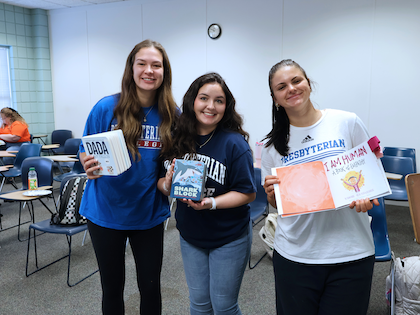
Student-led project supports learners with exceptionalities in local classrooms
What began as a student’s observation during a preschool practicum has grown into a collaborative service project aimed at expanding access to literacy for young learners with exceptionalities.
Special education majors at Presbyterian College recently organized a book drive and adapted children’s books for use in local classrooms, combining professional preparation with hands-on service.
A need identified in the classroom
The project was initiated by Caroline Murphy, a special education major from Greenville, who noticed a lack of adaptive reading materials while working in a preschool classroom.
“I didn’t feel like they had enough books that were adapted for the students,” Murphy said.
Murphy turned to social media to request donations, asking her community to contribute books and materials that could be modified for children with disabilities. The response was immediate, she said, with donated board books, toys and learning tools arriving within days.
When Murphy brought the materials back to campus, her classmates volunteered to help adapt the books.
Dr. Tammy Graham, professor of education and program director for the special education major, said the project exemplified student initiative and collaboration.
“I was incredibly touched by the quiet leadership and selfless initiative my students demonstrated,” Graham said. “This project illustrates the genuine hearts for service within our special education majors.”
Turning theory into practice
Adapted books are modified to increase accessibility, engagement and independence for students with exceptionalities. Unlike traditional children’s books, they may include tactile elements, simplified text, visual supports or physical modifications that help students with fine motor or communication challenges interact with the material.
Graham said students applied principles of Universal Design for Learning, a research-based educational framework, by incorporating textures, manipulatives, and page fluffers to assist children in turning pages independently. Some books also included short, thematic sentences designed to support comprehension for nonverbal or emerging readers.
Madison Crumpton, a psychology and special education double major from Fountain Inn, said the project highlighted a challenge she encountered in early childhood classrooms.
“It’s difficult to teach nonverbal three- and four-year-olds how to read when there are no books catered to them,” Crumpton said. “Teaching is also about advocating for your students and recognizing what they need.”
Personal connections to the work
For many of the students involved, their interest in special education is rooted in personal experience. Murphy said her own academic journey influenced her desire to advocate for others. Diagnosed with dyslexia in third grade, she attended Camperdown Academy in Greenville, a school for students with language-based learning differences.
“I’ve always needed accommodations and learned how to advocate for myself,” Murphy said. “I wanted to bring that into the classroom and advocate for other children.”
Marcello Coleman, a special education major from Jacksonville, Fla., and an offensive lineman for the Blue Hose football team, said his motivation stems from growing up alongside his older brother, who has Down syndrome.
“I was around special education classrooms and Special Olympics from a young age,” Coleman said. “I realized this is where my heart is.”
Coleman said the project addressed inequities he has seen between general education and special education resources.
“I heard about schools where special education students couldn’t take books home, but general education students could,” he said. “That’s not fair. This helps give them access.”
Building foundations through literacy
Maggie Judd, a special education major from Lyman, S.C., said the project reinforced the importance of literacy in early education. Judd, the inaugural winner of the college’s Service Entrepreneurship Competition, said access to appropriate books is foundational for learning.
“Reading is the basis of everything,” Judd said. “If students don’t have books they can actually use, their learning is delayed before it even begins.”
Judd said adapting books allows students to engage with stories in ways that meet their individual needs while also encouraging creativity and problem-solving among future educators.
Service as a shared value
Graham said the project reflects Presbyterian College’s motto, While We Live, We Serve, through meaningful action rather than recognition.
“My students often serve individuals with exceptionalities in their communities without seeking attention,” she said. “They empower others to become more independent.”
Students said the experience also affirmed their decision to attend Presbyterian College. Crumpton said the campus felt like home when she arrived and credited faculty with encouraging her to explore new academic paths.
Judd, now nearing graduation, said relationships with faculty and staff across campus helped her grow personally and professionally.
“I know I made the right choice coming to PC,” Judd said.
Murphy said the project clarified her future goals and strengthened her sense of belonging.
“I want to be in a preschool classroom working with students with exceptionalities,” she said. “PC helped me realize this is exactly where I’m supposed to be.”
As the adapted books are placed into local classrooms, students said they hope the project’s impact will extend beyond the materials themselves, shaping both young learners’ experiences with reading and the values future educators carry into their classrooms.