







The good, the bad and the ugly about ‘Light-Horse Harry’ Lee
January 14, 2026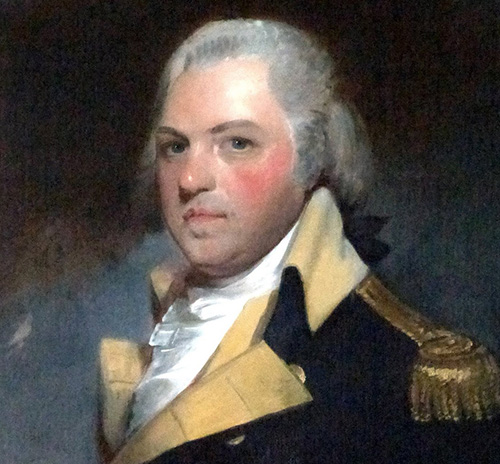
He was the father of Robert E. Lee. And so much more.
Mike Burgess, an outspoken, award-winning high school history teacher, will deliver a free lecture about Revolutionary War hero Henry Lee III at the South Carolina Confederate Relic Room and Military Museum at noon on Friday, Jan.30, 2026. His lecture, “Wedded To My Sword: The Life, Legend, and Legacy of Henry ‘Light-Horse Harry’ Lee,” is part of the Relic Room’s regular Noon Debrief program, and the public is invited.
“I became interested in Lee for one reason — the son!,” said Burgess, who teaches at River Bluff High School. “I quickly learned that this Lee is a military legend in his own right and has as compelling a story as his son. Though unlike the immortality attained by his son, in some ways he has faded.”
Lee was born in Prince William County, Virginia, and was a member of one of that state’s most prominent families. His father’s first cousin was Richard Henry Lee, one of the president of the Confederation Congress (which made the new country’s laws in the years before our Constitution was adopted). His mother’s niece was married to Gov. Thomas Nelson Jr. His great-grandmother was great-aunt of President Thomas Jefferson. His great-great grandfather was William Randolph, who had been speaker of the Virginia House of Burgesses at the end of the 17th century.
So much for his background. When the Revolution broke out at Lexington and Concord in 1775, Lee became a captain in a dragoon detachment in the Colony of Virginia. He was promoted to major in 1778, after which he earned his reputation as a capable leader of light troops as commander of a mixed corps of cavalry and infantry called “Lee’s Legion.” That was when he earned his nickname. In 1779, the Continental Congress voted to present Lee with a gold medal, an honor given to no other officer below the rank of general, for the “Legion’s” actions during the Battle of Paulus Hook.
At that point, he was promoted to lieutenant colonel and sent, with his “Legion,” to South Carolina.
“He comes south with a reputation for audacity, boldness, and winning,” notes Burgess. However, “It will test his desire for patriotic virtue and order. As well as the discipline of him and his men.”
Lee’s career was somewhat checkered by controversy, and Burgess divides his performance in South Carolina into three categories: The Good, The Bad, and The Ugly.
Burgess has spoken to Noon Debriefs several times before, and has concentrated a good deal on this period of our history. He has been named the Gilder Lehrman South Carolina History Teacher of the Year and South Carolina Daughters of the American Revolution Outstanding Teacher of American History. He is a fearless, outspoken advocate for improved history education in our schools.
“History must be taught fully, fairly, and honestly. Without it, we lose our understanding of the past, fail to explain the present, and squander the hope of building a brighter future,” he said recently. “And we’re failing to do that at a particularly bad time.”
About the South Carolina Confederate Relic Room and Military Museum
Founded in 1896, the South Carolina Confederate Relic Room and Military Museum is an accredited museum focusing on South Carolina’s distinguished martial tradition through the Revolutionary War, Mexican War, Civil War, Spanish-American War, World Wars I and II, Vietnam, the War on Terror, and other American conflicts. It serves as the state’s military history museum by collecting, preserving, and exhibiting South Carolina’s military heritage from the colonial era to the present, and by providing superior educational experiences and programming. It recently opened a major new exhibit, “A War With No Front Lines: South Carolina and the Vietnam War, 1965-1973.” The museum is located at 301 Gervais St. in Columbia, sharing the Columbia Mills building with the State Museum. For more information, go to https://crr.sc.gov/.