








The Ghosts Of Winter
February 18, 2026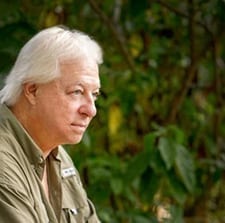
By Tom Poland
Fall in full tumble gives us a kind of X-ray vision. We see that a leafless land is a lovely land, a surprising land. We see what leaves hide. What we miss summer when we drive blind. Green clusters of mistletoe festoon the barren crowns of oaks. Abandoned shacks and mansions. Silos commandeered by woods. It’s like driving through a place for the first time. Really seeing. Seeing the ghosts of winter.
We tire of winter’s barren days but they bless us with rare images. When the days shorten, we trade leaves for visions. I glance at the old Hard Labor Creek Bridge on Hwy 378 in McCormick County. Unveiled, there it stands, that old ghost bridge bereft of traffic, save the occasional deer hunter or coyote. A favorite to photograph, too, is the old Hwy 25 Bridge in Edgefield County, but it requires a good walk.

A ghost bridge bordered by white bones against a blue sky. Photo credit Tom Poland.
Imagine this. You’re driving a country road on a December morning. To your left the sun lights up hardwoods and within them smooth white sycamores blaze up. For a moment, no other trees exist save those chalk-white trees. You stare because you cannot help it. Where have these beauties been? Well, we have other white-bark trees down here … river birch and paper birch come to mind, but sycamores have no rivals, not in my mind. Aspens out West seem rival worthy but they’re out West. I would love to find aspens and sycamores in one setting. Only then could I settle this matter of tree brilliance. I should add that photographing sycamores in winter light often tints them blue. Snow too.
A long time ago I was driving through North Georgia Mountains near Helen when something drew my eyes into snowy woods. Among flakes as big as quarters, the mystical ghost, an albino buck, stood in snow-crusted hardwoods, antlers white as sycamores. I said, “white as sycamores”.
This winter as you drive this land, get out into the country and take the lesser roads, which in reality or the greater roads. Scan the woodlands. Up ahead you see a bridge crossing a creek. Keep your eyes peeled as my Grandmother used to say. Crossing the old bridge with its ka-thump, ka-thump rhythmic sections you glance right. You see brilliant white trunks. Sycamores. White as bones.
I am conditioned. When I think of sycamores, I see white. White as bones. You can substitute white with milky, snowy, papery as in paperwhites, bleached, chalky, ivory, but never colorless. Come winter these trees are all about color. To start, they make a striking sight against a cobalt sky. They stand out in dark woods on light-abbreviated winter days.
When I think of sycamores I recall 10 measured words an editor spoke to one of my writing class student’s long ago. A young woman asked him a question.
“Sir, how do you know a good writer when you see one”?
He paused, then spoke.
“They write like angels. Their words leap off the page.”
How will you know a sycamore when you see one? Their tell-tale whiteness will not be lost on your summer-blinded eyes. Sycamores will leap into your eyes, these trees that light up winter days. Tall, with a majestic crown, they’ve seen good use. American Indians hollowed out their trunk to make canoes. Their sweet sap can be turned into syrup and sugar.
Sycamores will turn your winter drive into majesty. Should you park to get a closer look, be prepared. Like so many things in life, sycamores prove a bit deceptive. From afar you see that pure white trunk but up close you’ll see patches of green and brown like some brockle-faced species. Perfection is elusive but on a winter drive, sycamores come close. Very close. A leafless land is, indeed, a lovely land, a surprising land.
Photo credit Tom Poland.
Georgia native Tom Poland writes a weekly column about the South, its people, traditions, lifestyle, and culture and speaks frequently to groups in the South. Governor Henry McMaster conferred the Order of the Palmetto upon Tom, South Carolina’s highest civilian honor, stating, “His work is exceptional to the state.” Poland’s work appears in books, magazines, journals, and newspapers throughout the South.
Visit Tom’s website at www.tompoland.net
Email him at [email protected]