Serving Up Change: South Carolina to Enforce Mandatory Alcohol Server Training This Monday
February 26, 2026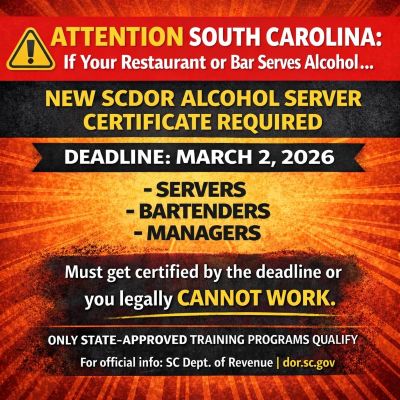
A significant shift in South Carolina’s hospitality industry officially begins this weekend. Starting Monday, March 2, 2026, the state will begin enforcing the Responsible Alcohol Server Training Act, a new law that mandates specific certification for anyone serving alcohol for on-premises consumption.
The law, which was signed last year, ends a long period of voluntary training in the Palmetto State. As of Monday, “friendly warnings” from the South Carolina Department of Revenue (SCDOR) will be replaced by strict compliance checks and financial penalties for businesses that fail to meet the new standards.
Who Needs Certification?
The new mandate does not apply to every employee at a restaurant or bar, but it covers a wide swath of the workforce in the Golden Strip and beyond. Specifically, training is now required for:
-
Employees who work 10 or more hours per week serving alcohol for on-site consumption.
-
All managers who oversee or supervise alcohol service.
-
Owners or licensees who personally function as alcohol servers or managers.
New hires have a small grace period; they must obtain their certificate within 30 days of their employment date. However, for those already employed as of February 1, the deadline to be fully certified is this Monday.
What the Training Covers
To receive the state-issued Alcohol Server Certificate, staff must complete an SCDOR-approved program. These courses go beyond simple mixing and pouring, focusing heavily on safety and legal liability. Key subjects include:
-
Identifying visibly intoxicated patrons and intervention techniques.
-
Proper methods for checking IDs and spotting forensic digital fakes.
-
South Carolina-specific laws regarding concealed weapons in bars.
-
Understanding blood alcohol concentration (BAC) and the effects of alcohol on the body.
One unique aspect of the new law is the requirement for late-night venues. Businesses serving alcohol between midnight and 4:00 a.m. are now required to use a forensic digital ID verification system to authenticate patrons’ ages.
Fines and “Three Strikes” Penalties
The state has introduced a tiered penalty system to ensure establishments take the mandate seriously. Failing a compliance check can be costly:
-
Certification Violations: Businesses can be fined $500 per violation for allowing an uncertified employee to serve alcohol, and $100 for failing to produce a copy of a certificate during inspection.
-
Business License Penalties: A first offense for general non-compliance carries a fine of up to $2,500. A second offense within two years can lead to a 14-day license suspension, while a third offense within three years can result in permanent revocation of a liquor license.
The “Why” Behind the Law
The push for mandatory training comes as South Carolina businesses grapple with some of the highest liquor liability insurance premiums in the country. By mandating training and ID scanners, the state hopes to reduce alcohol-related incidents and provide businesses with “risk mitigation” that may eventually help lower insurance costs.
For servers in Mauldin and Simpsonville, the message is clear: the era of “learning on the job” when it comes to alcohol safety is officially over. Certificates (physical or digital) must be kept on-site and ready for immediate inspection starting March 2.