







Clemson chemistry student turns undergrad research and interest in AI into startup company
March 24, 2026
Lukas Garcia is representing Clemson in the ACC InVenture Prize competition with Crystal-XG, which has the potential to transform how scientists create and study crystals.
What happens when chemistry collides with artificial intelligence?
For Clemson University sophomore Lukas Garcia, the result is a tech startup, Crystal-XG, which has the potential to transform how scientists create and study crystals, a critical step in pharmaceutical development.
Officially incorporated as a limited liability company in South Carolina earlier this year, Crystal-XG grew out of Catalyst, a two-semester Creative Inquiry course that teaches students how to identify business opportunities, translate ideas into products and pitch them to funders.
Garcia and his team took their concept from the classroom to competition, winning the College of Science’s annual Catalyst Competition and the university-wide Launchpad Liftoff competition last spring. They continued their momentum in the fall, placing first among 155 teams at the state-wide Palmetto Pitch competition and receiving over $15,000 in non-dilutive funding.
Now, Garcia will represent Clemson at the ACC InVenture Prize competition in March. The ACC InVenture Prize is an innovation competition in which teams of undergraduates representing each Atlantic Coast Conference university pitch their inventions or businesses before a live audience and a panel of judges, competing for $30,000 in prizes.
There is also a People’s Choice Award. Voting opens on Monday, March 23 and closes on Friday, March 27. To vote, go to the teams page, select your favorite and text the code of the team that you want to win to 415-965-7445.

Ninety percent of pharmaceutical compounds, such as ibuprofen and the vitamin pills we take each morning, are actually crystals.
Growing area of study
When Garcia first came to Clemson, he began his journey in undergraduate research at the Molecular Structure Center, Clemson’s crystallographic lab. His project focused on synthesizing halogen-bonded crystalline materials, an increasingly significant area in materials science and pharmaceutical development.
“Ninety percent of all pharmaceutical compounds, such as ibuprofen and the vitamin pills we take each morning, are actually crystals,” said Garcia, who is majoring in chemistry and minoring in AI.
However, creating medicinal crystals for the market can be a tricky process. Crystallization depends largely on a step called nucleation, something scientists still can’t fully control. As a result, making a single crystal often involves trial and error, requiring extensive experimentation.

While some scientists have developed screening tools using thermodynamic and computational techniques, these tools are often inaccurate. After spending time in a crystallography lab, Garcia began to notice how much time, effort and environmental impact were tied to these inefficient methods.
To solve this problem, Garcia developed a machine-learning algorithm that can guide scientists in crystallizing specific molecules. The technology could save time and resoures while speeding up the process of bringing new drugs to the market. To create the algorithm, Garcia analyzed 940 different scientific papers and compiled a dataset of over 10,000 experiments, creating the most extensive and largest collection of crystallization conditions in the entire world.
Now, in collaboration with Clemson’s Molecular Structure Center, Garcia is training his algorithm and is preparing to publish these results. Several labs across the world have already implemented the algorithm to validate its effectiveness.
Growing a business
After the startup began to grow, Garcia started building a team, hiring three students from Rice University, Princeton University and the University of North Carolina at Chapel Hill.
Garcia has started meeting with investors for his startup and holds a provisional patent. He plans to publish his research before moving toward commercialization. Most recently, Crystal-XG has become the youngest member company ever backed by the South Carolina Research Authority (SCRA), marking a significant milestone in its growth trajectory.
After graduating from Clemson, Garcia intends to pursue his Ph.D. and eventually become a professor with research interests in materials science and artificial intelligence.
His passion for chemistry began after he took an organic chemistry class in high school and participated in electrochemical research. His father, Carlos Garcia, a professor in the Clemson Department of Chemistry, sparked his interest in interdisciplinary work and has shaped his academic path profoundly.
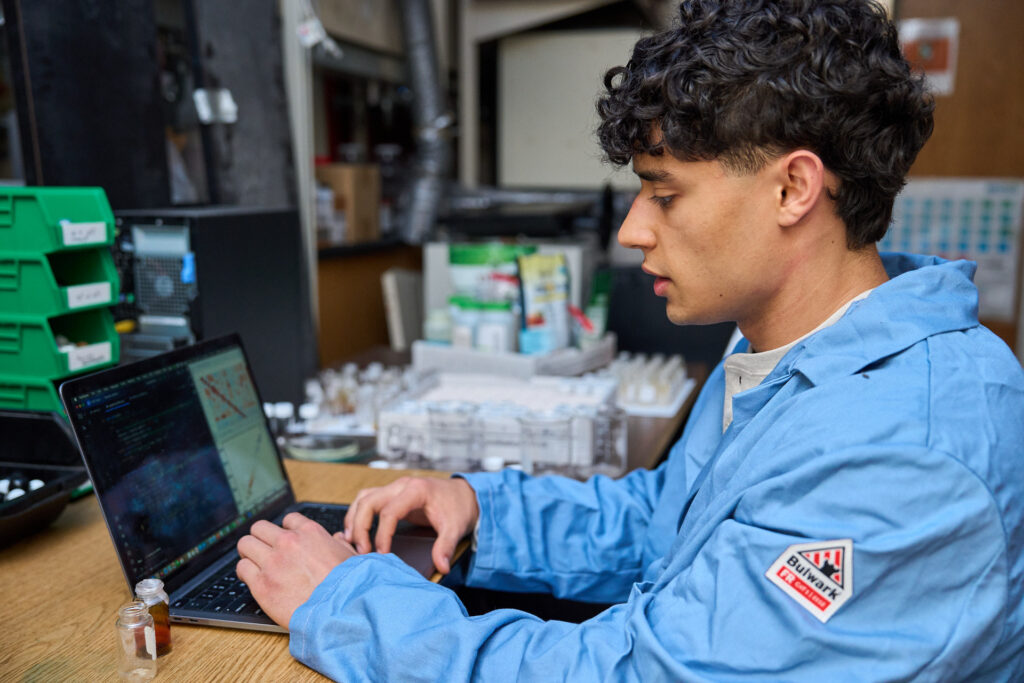
Lukas Garcia won the Clemson College of Science’s Catalyst Competition in 2025 with Crystal-XG.
Garcia credits his success to his mentors, including William Pennington, professor and previous chemistry department chair, and Colin McMillen, a principal lecturer in the chemistry department, who helped develop his skills in structural chemistry. He completed two Research Experiences for Undergraduates (REUs) under their supervision and has continued this work in Creative Inquiry during the academic year.
“They’ve been fantastic mentors, always encouraging me to try new ideas and experiments,” Garcia says. From his time in the lab, he now has two first-author research papers under review, both focused on the characterization and synthesis of inorganic crystalline materials.
Outside the lab, Garcia volunteers for the Clemson University Paralympic soccer team, allowing him to give back directly to his community and support his peers as they train to compete at the International Federation of Cerebral Palsy Football (IFCPC) World Cup.
“They’re U.S. national team players, and Clemson’s the only college Paralympic soccer program in the country,” Garcia says.
For Garcia, volunteering is a meaningful way to invest in others, reflecting the same dedication to making an impact that shapes his work as a scientist.