









A Court Comes to Campus: South Carolina Supreme Court Holds Historic Session at Presbyterian College, Bringing ‘Civics Lesson on the Road’ to Students and Community
April 6, 2026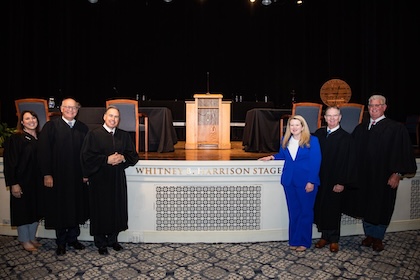
Two-day event in Belk Auditorium offers rare, firsthand look at justice in action for Upstate audiences
For two days, the South Carolina Supreme Court traded its courtroom in Columbia for a stage in Clinton, offering students, educators and community members a rare opportunity to see justice unfold in real time at Presbyterian College.
The special session, held March 31–April 1 in Belk Auditorium, marked a significant outreach effort by the state’s highest court — one Chief Justice John W. Kittredge described as a “civics lesson on the road.”
“This is about bringing the court to the people,” Kittredge said, noting the strong turnout of students from across South Carolina. “We’ve been blown away by the interest.

For PC President Anita Gustafson, the moment carried both institutional and civic significance.
“We are genuinely grateful you have chosen Presbyterian College for this historic occasion,” she said in welcoming remarks. “Our students are watching real arguments before the highest court of South Carolina. They are seeing — not just reading about — how justice is argued, decided and delivered.”
Gustafson framed the event as part of a broader mission to expand access to learning and civic understanding.
“This is a statement about who justice belongs to,” she said. “It belongs to everyone in every corner of this state.”
Drawing on her background as a historian, Gustafson also reflected on the court’s legacy, noting its origins in the 1868 state constitution and its role as “the guardian of the rule of law” for more than 150 years.
Learning in Real Time
The audience included students from across the region — from middle schools to high schools and college classrooms — many experiencing oral arguments for the first time.
That exposure, Gustafson said, is transformational.
“Some of them will leave this room and carry what they witnessed into careers in law, public service, medicine, education and business,” she said.
“They will carry it into their communities and into the world to make a difference.”
That sentiment was echoed by Whitney Harrison, a 2007 PC graduate, trustee and appellate attorney with McGown, Hood, Felder & Phillips in Columbia. The sessions took place on the Whitney B. Harrison Stage, named in recognition of her support for the college.
“Presbyterian College is a place where people discover their calling,” Harrison said.
Harrison, who once clerked for the state Supreme Court, described appellate law as work that shapes legal precedent for generations.
“Appellate courts are not here to decide what happens,” she said. “Their job is to determine what the law should be and how it should be applied.”
For students in attendance, she added, the experience offers a glimpse into that process — one that demands precision, persistence and a deep sense of responsibility.
“I hope each of you finds your calling and has the courage to follow it,” Harrison said.

Hosting the court required weeks of coordination across campus and beyond, with Gustafson and others recognizing the contributions of faculty, staff and community partners who made the event possible.
Local and state leaders also emphasized the broader impact of bringing the court to Laurens County.
“This is truly a great laboratory experience,” said S.C. Sen. Danny Verdin, who represents District 9. “Bless you for bringing the courthouse to Laurens County.”
Verdin placed the visit in a wider historical context, noting the long-standing importance of law and justice in shaping communities.
“An exceptional experience is before us today,” he said, adding that its effects “will be long-lasting and measured in years to come.”
State Rep. Doug Gilliam echoed that sentiment, calling the event a rare opportunity for citizens to witness the judicial process firsthand.
“This is democracy in action,” Gilliam said.
Bridging Classroom and Courtroom
Throughout the sessions, the justices heard oral arguments in a range of cases, including civil and criminal appeals involving issues such as immunity under state law, jury procedures and post-conviction relief.
But for many in attendance, the substance of the cases was secondary to the experience itself — seeing how legal arguments are presented, questioned and weighed at the highest level.
Kittredge emphasized that point, encouraging students to engage with the process and recognize its relevance to their lives.
“We hope this is an enjoyable experience for you,” he said, addressing the audience of students and educators.
Lasting Impact
For Presbyterian College, the visit represented more than a two-day event. It was a convergence of mission, opportunity and public service — one that connected classroom learning with real-world application.
By bringing the Supreme Court to campus, Gustafson said, the college created a moment that could shape how students understand both their education and their role in society.
And for those who filled Belk Auditorium — from aspiring attorneys to curious middle schoolers — the experience offered something rare: a close-up view of how justice works, and who it serves.
As Verdin noted, the significance of that moment may not be fully realized until years later.
But its impact, he suggested, is already underway.