Georgetown’s Original Jail and Courthouse
April 6, 2026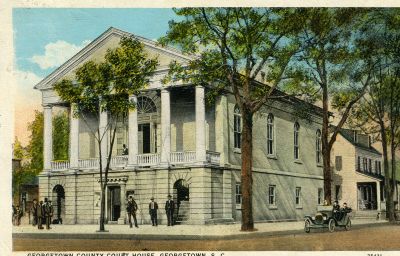
Welcome to a new series dedicated to the stories that shaped Georgetown, South Carolina—the third-oldest city in the state. From the strategic maneuvers of the Revolutionary War to the cultural evolution of the “Rice Coast,” this series explores the legends and landmarks that define our heritage. Join us as we look beyond the modern landscape to discover the people and events that paved the way for the Georgetown we know today.
By Mary Boyd
The original plan of Georgetown of 1729 established lots 149 and 150 on the corner of King and Broad Streets for “a townhouse or ‘tholsel’, courthouse and prison.” Apparently, these lots were never used for that purpose. Not until 1769 did the legislature pass the Circuit Court Act, and the commissioners appointed to secure land and erect a courthouse and “gaol” on lots 155 and 156 at the corner of Duke and Broad Streets. Evidence indicated the first courthouse and gaol were built on lot 156. By 1783, they were in need of repair.
It is believed that British soldiers were quartered in and around these two public buildings during the Revolutionary War occupation of 1780 to 1781. Some of their horses were stabled inside Prince George Church just down the street.
Records show that these two buildings were frequently in disrepair. Petitions to the Legislature in 1783, 1791, 1808 and 1811 were made to request funds for serious repairs. In 1820, the State Engineer described the building thus, “The Court House in this district is a large wooden building of two stories upon a brick foundation. The repairs contracted for were in a state of progression when I last visited it. The building has been greatly injured from exposure and other abuses. The gaol is built of brick, two stories high and is covered with shingles. It requires considerable repair and a few alterations to render it comfortable; for this purpose, an appropriation will be necessary. The Magazine is of brick, enclosed in a brick wall.” Storms in 1820 and 1822 inflicted damages to the buildings and caused the loss of public records. However, repairs must have been made to the jail, because a new one was not erected until 1845.
After the storm of 1822, the Courthouse was so badly damaged as to render it unfit. A new courthouse was designed by Robert Mills, famous South Carolinian who also planned the Washington Monument. The new courthouse was built on lot 64 at the corner of Screven and Prince and opened in 1824. It was described as a great ornament to the town. By 1853, the courthouse had fallen into a state of disrepair. Commissioners noted that the first floor offices needed to be enlarged. Apparently, the repairs were adequate throughout the next decades.
The jail limped along in use at its location at Broad and Duke for years after 1822, but was always a source of concern in its “unhealthy” state. Finally, in 1844, lots 135 and 136 were offered for sale, located on the northwest corner of Highmarket and Screven Streets. The forward portion of this lot facing Highmarket Street was purchased and a large, three story, brick jail was erected. The first floor was Sheriff’s Office, the second floor residence for the Sheriff’s family, and the third floor contained four cells for the prisoners. A brick wall of approximately 8 feet high was erected around the entire jail and yard.
During the mid 1950s, the jail became the Georgetown County Library. With no need for cells, the third floor was removed , and the height of the wall reduced. Some of the bricks were used to build an auditorium for the library. Today, this building serves as the offices and Parish Hall for Prince George Winyah Church. What an interesting progression of usage over the years – first by law enforcement, then literary arts, and now religion.
About the Author
Mary Boyd is a dedicated local historian with a deep passion for preserving and sharing the rich narrative of Georgetown County. She is associated with the Georgetown County Historical Society Museum and the Francis Marion Interpretive Center. Boyd welcomes queries about Georgetown’s history and heritage at info@georgetowncountymuseum.