







Historic Columbia announces 2026 Preservation Award winners
May 19, 2026
Awards honor individuals and projects for design and preservation accomplishments
Historic Columbia announced the recipients of its 2026 Preservation Awards, an annual program held in conjunction with Preservation Month that honors outstanding projects and individuals contributing to the preservation of Columbia and Richland County’s historic, architectural, and cultural resources.
The awards recognize exemplary rehabilitation, restoration, and new construction projects that demonstrate a commitment to thoughtful preservation and design, as well as leadership that advances the stewardship of the community’s historic places.
“Preservation is about more than protecting buildings. It’s about honoring the stories, craftsmanship, and sense of place that define our city,” said Suzanne Brooks, Executive Director of Historic Columbia. “Through the Preservation Awards, we have elevated projects that demonstrate what thoughtful stewardship can achieve.”
Historic Columbia awarded recipients in the following categories:
- Preservation Leadership; Traditional Building Arts
- Preservation, Rehabilitation, or Restoration (Commercial, Institutional, Rental, or Municipal)
- Revitalization(Any Ownership or Use); and
- Preservation, Rehabilitation, or Restoration (Residential/Single-Family)

Preservation Leadership
Lydia Mattice Brandt
Professor of Art History, University of South Carolina
Lydia Mattice Brandt, Ph.D., has significantly shaped how Columbia understands and engages with its built environment through her work as a professor, scholar, and preservation advocate at the University of South Carolina. Since 2011, she has integrated architectural history and preservation into her teaching using Columbia’s own historic resources, while also advancing major documentation projects such as National Register nominations and a comprehensive downtown survey. Her work has expanded recognition of historic places, supported public history initiatives, and strengthened preservation practice across the city through research, education, and community engagement.
Preservation Leadership
Main Street District
In the late 1990s, downtown Columbia’s Main Street was underutilized, with limited retail activity and little residential presence. The Main Street District (MSD), originally formed as Center City Partnership, helped transform the area by advancing a preservation-led approach to economic development. Its advocacy supported the National Register listing of the Columbia Commercial Historic District in 2014, expanding access to federal tax credits and preservation tools that incentivized reinvestment in historic buildings. Since then, targeted preservation projects have driven significant increases in property values, employment, small business growth, and downtown housing.
Traditional Building Arts
Conway Architectural Salvage and Heritage Project
Conway Salvage is a grassroots nonprofit founded in 2023 by Alan Todd and Sara Keever to reduce the loss of historic building materials through deconstruction, education, and community engagement. The organization combines material salvage, documentation, and preservation of traditional building knowledge while offering public workshops and volunteer opportunities. Its work gained statewide attention in 2025 through the careful deconstruction of 900 Main Street in Columbia, where more than 90 percent of materials were salvaged for reuse and community oral histories were collected to preserve the site’s cultural memory.

Bob Russell Realty Building | 1931 Assembly Street
Lewis Rogers Properties — Property Owner
Architectural Concepts — Architect
Blackstone Construction — Contractor
Rogers Lewis Group – Preservation Consultant
Constructed in 1967 at the southwest corner of Assembly and Calhoun streets, the Bob Russell Realty Building is a strong example of New Formalist architecture defined by its structural grid, travertine panels, ribbon windows, and classical detailing. In 2024, the largely gutted interior was carefully rehabilitated by a preservation-focused team working from surviving architectural evidence to reconstruct office layouts and circulation spaces. Significant interior features including wood paneling, travertine flooring, built-in planters, and the vestibule rock garden were preserved or restored, while exterior work remained minimal to maintain the building’s original façade and design integrity.

Central Fire Station | 1001 Senate Street
Raines Company — Property Owner
Garvin Design Group — Architect
Mashburn Construction — Contractor
Rogers Lewis Group – Preservation Consultant
Constructed between 1949 and 1951, the former Columbia Central Fire Station has been rehabilitated into a boutique hotel that adapts the historic complex for new use. The project retained key elements of the headquarters, garage, and drill tower, including original hardscape, structural forms, and interior spatial qualities, while transforming former apparatus bays into lobby and lounge space and introducing guest rooms through sensitive additions and conversions. Thanks to its successful blending of original and contemporary elements, The Lantern Hotel preserves an important piece of Columbia’s mid-century civic history while bringing new energy to the Congaree Vista district.

Horry-Guignard House | 1527 Senate Street
University of South Carolina — Property Owner
BOUDREAUX — Architect
Hammer Construction — Contractor
The Horry-Guignard House, built around 1913, continues its long tradition of service. A research-driven, phased rehabilitation has preserved its historic fabric while adapting it for continued use. Exterior work restored the porch, masonry, windows, siding, and roof while addressing structural and drainage issues. Interior upgrades introduced modern systems and accessibility improvements to support its use to support veterans and the next generation of legal advocates as the University of South Carolina School of Law’s Veterans Law Clinic.

Olympia Armory | 551 Granby Street
South Carolina Military Department — Property Owner
Garvin Design Group — Architect
Solid Structures — Contractor
Garvin Design Group – Preservation Consultant
Constructed in 1937 with funding from the Works Progress Administration, the Olympia Armory was recently rehabilitated to ensure its continued use as both a military facility and a community venue. Modern systems were carefully integrated to enhance safety and accessibility while preserving the historic character of the structure. The removal of later alterations revealed a historic stage and reopened the full drill hall, restoring character-defining features and highlighting the original materials of this National Register of Historic Places property.
 Preservation, Rehabilitation, or Restoration (Commercial, Institutional, Rental, or Municipal)
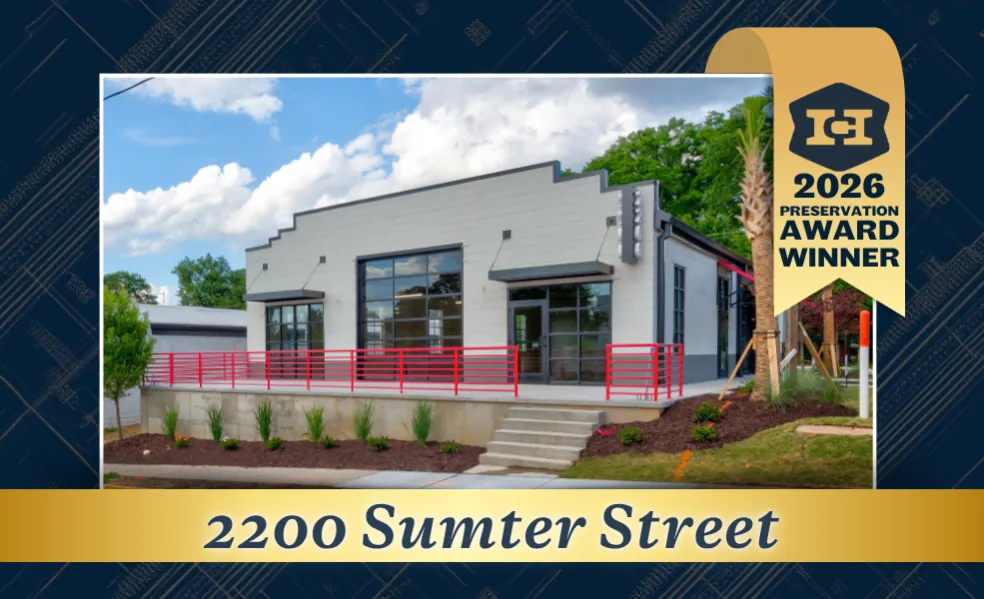
2200 Sumter Street
Yip Premier Real Estate — Property Owners
Architrave — Architect
Cohn Construction — Contractor
Erected in 1964, the building at 2200 Sumter Street underwent a comprehensive rehabilitation that addressed long-standing structural and maintenance issues while preserving its character-defining features. Reopened storefront openings and compatible exterior improvements restored transparency and strengthened the building’s relationship to the street, while the new meeting spaces inside strengthen the building’s relationship to the community. Features like the restored steel windows and distinctive bowstring trusses illustrate how preserving character-defining elements can transform a formerly utilitarian structure into a vibrant neighborhood asset.
 Revitalization (Any Ownership or Use)
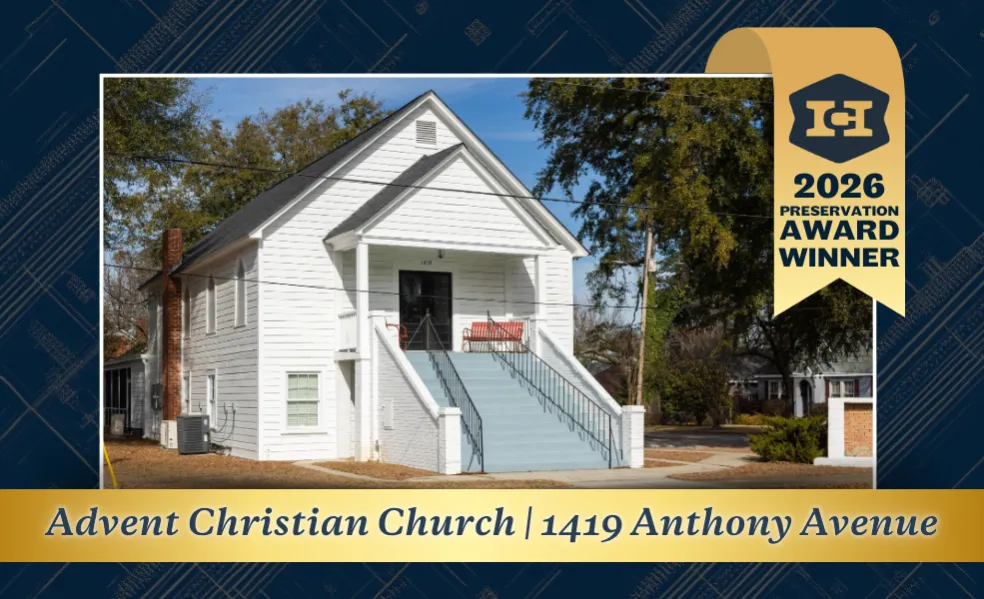
Advent Christian Church | 1419 Anthony Avenue
Gretchen Lambert and Stanford Gardner — Property Owners
The rehabilitation of 1419 Anthony Avenue demonstrates how adaptive reuse can successfully transform a historic church into a private residence while preserving its architectural character. Exterior work reversed later alterations, while inside, the former sanctuary was adapted for living space while retaining key historic features like a baptismal font. Thoughtful interior reconfiguration allowed new residential uses, illustrating how historic buildings can evolve while keeping cultural stories alive.
 Revitalization (Any Ownership or Use)
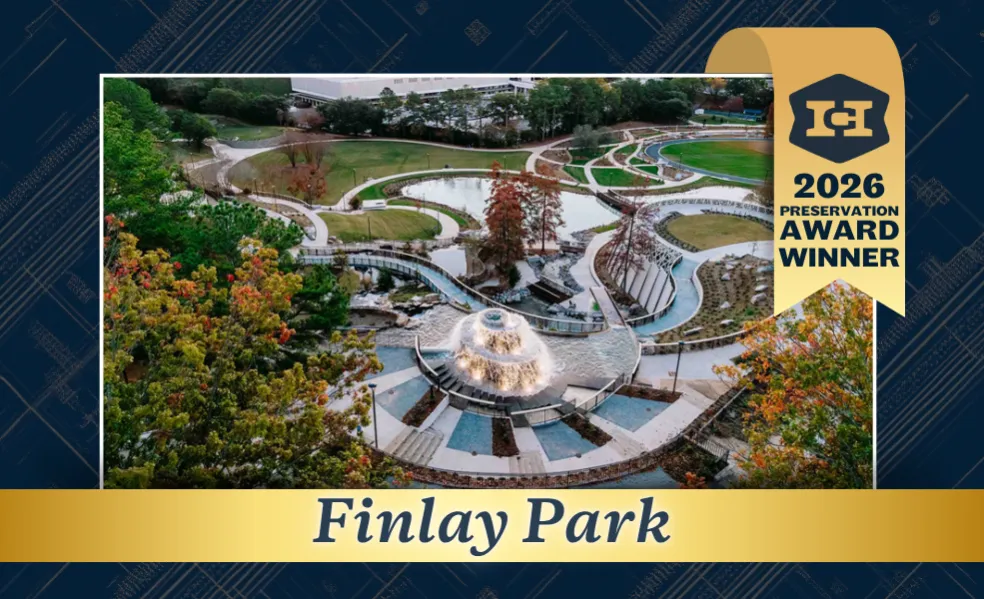
Finlay Park | 930 Lauren Street
City of Columbia — Property Owner
LS3P — Architect and Consultant
Mashburn Construction — Contractor
Stantec Consulting Services Inc. — Landscape Architects
The $24 million revitalization of Finlay Park restored this once-beloved downtown green space after years of deferred maintenance and declining use. While respecting the park’s historic character, new recreational amenities, performance spaces, and safety improvements were thoughtfully integrated into the landscape, reestablishing the park as a vibrant public destination for social, cultural, and recreational life in downtown Columbia.
Revitalization (Any Ownership or Use)
Pickens Street Cottages | 1527 Gervais Street
1527 Gervais Phase 2, LLC — Property Owner
Brennan Works — Architect
McGuinn Homes — Contractor
Rogers Lewis Group — Preservation Consultant
The Pickens Street Cottages illustrate how thoughtful new construction can strengthen a historic neighborhood. Replacing a long-used parking lot, the project introduced eight small-scale residential buildings that reflect the rhythm and character of earlier homes in the neighborhood. Designed to complement nearby historic architecture without mimicking it, the cottages use compatible materials, traditional details, preserved trees, and discreet rear parking to create housing that feels contemporary while reinforcing the historic streetscape.
Preservation, Rehabilitation, or Restoration (Residential/Single-Family)
A.S. Salley Library & Office | 1917 College Street
Archie and Sarah Parnell — Property Owners
Ari Renovations — Contractor
State Historic Preservation Office — Preservation Consultant
Preservation often depends on the careful work that happens behind walls and beneath floors, and the rehabilitation work at 1917 College Street focused on these types of critical structural and infrastructure improvements. While the building remained largely intact, significant drainage and foundation issues threatened its longevity. The project prioritized regrading, drainage corrections, and structural reinforcement, along with major electrical and plumbing upgrades. Though largely invisible, these improvements restored the underlying heath of this ca.-1909 home to remain functional for decades to come.
Historic Columbia would like to thank the members of the 2026 Preservation Awards committee, including Dale Marshall (Chair), Eugene Bell, Dewey Ervin, Mickie Hoover, Chris Rose, and Tiara Williams. The 2026 Preservation Awards were made possible by support from GBX Group, Goings Law Firm, Richard Hampton Jenrette Foundation, Southern Way Catering, and Styx Companies.