








A Symbol Born of Revolution: The History of the American Flag and Flag Day
June 15, 2026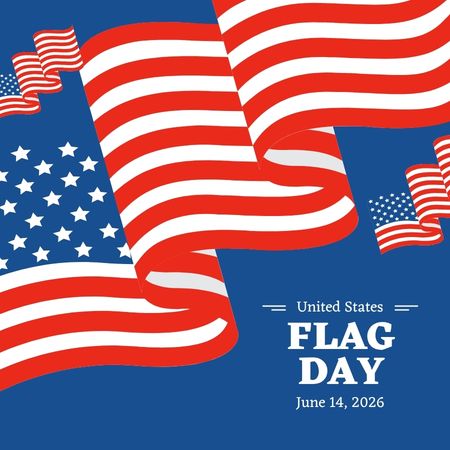
As the United States marks its 250th anniversary in 2026, Flag Day carries added significance this year. Observed this past Sunday (every June 14), the day commemorates the moment the young nation first defined the banner that would come to represent it, and in 2026 that anniversary falls during the Semiquincentennial celebration of two and a half centuries of American independence.
The story begins on June 14, 1777, when the Second Continental Congress passed the Flag Resolution. It declared that the flag of the United States would consist of 13 stripes, alternating red and white, with a union of 13 white stars in a blue field representing a new constellation. The resolution did not specify how the stars should be arranged, which is why flags from the era show them in circles, rows and other patterns.
The flag’s origins are wrapped in legend. The popular story credits Philadelphia seamstress Betsy Ross with sewing the first flag, though historians have found little evidence to support it, and the account did not surface publicly until 1870. Many historians instead credit Francis Hopkinson, a New Jersey signer of the Declaration of Independence, who later sought payment from Congress for his design work.
As the nation grew, so did the flag. The Flag Act of 1818 fixed the number of stripes at 13 to honor the original colonies and provided that a star would be added for each new state. The flag has been modified 27 times since 1777. The current 50-star design, the longest-serving in the nation’s history, was adopted in 1960 after Hawaii became a state.
Flag Day itself grew out of grassroots effort. The idea is widely traced to Bernard Cigrand, a Wisconsin schoolteacher who began campaigning for a national observance in 1885 and is often called the Father of Flag Day. President Woodrow Wilson established June 14 as Flag Day by proclamation in 1916, and President Harry Truman signed the act of Congress designating the date in 1949.
While Flag Day is not a federal holiday, communities across the country mark the occasion with ceremonies, parades and patriotic displays. The date also serves as the birthday of the United States Army, which was established on June 14, 1775, two years before the flag was adopted.
From its beginnings in a Revolutionary War resolution to the 50-star banner that flies today, the Stars and Stripes has endured as a symbol of freedom, unity and national identity, and 2026 gives Americans a particular reason to reflect on what it represents.