


Fall 2025 ART Academy pitch competition recognizes research innovation, real-world impact
November 25, 2025
Clemson University’s STRIDE ART (Accelerating Research Translation) Academy recently concluded its Fall 2025 cohort with a competitive pitch event at the Barnes Center. This semester’s cohort featured 17 participants in 14 teams representing six different colleges at the University.
“The research faculty within Clemson are the catalysts to bring forth translational research with real world impact to the communities and industries we serve,” said Craig Kinley, STRIDE Program Coordinator. “Their individual and collective engagement in our program will deliver the next steps of the journey to successful ventures such as licensing, commercialization and/or societal impact around the world.”
The pitch competition marked the end of this semester’s seven-week ART Academy program, a “Research Translation 101” course for research faculty. The Academy aims to foster an environment where ideas can flourish, leading to tangible outcomes and a culture of impact-driven innovation. The Academy serves as an informative incubator for STRIDE’s core mission of transforming cutting-edge research into real-world applications and meaningful solutions that benefit society.
The competition featured six top teams presenting to an audience of fellow research faculty, graduate students and members of the STRIDE ART Academy. The audience served as judges, casting their votes based on technical feasibility, competitive position, and market/societal impact.
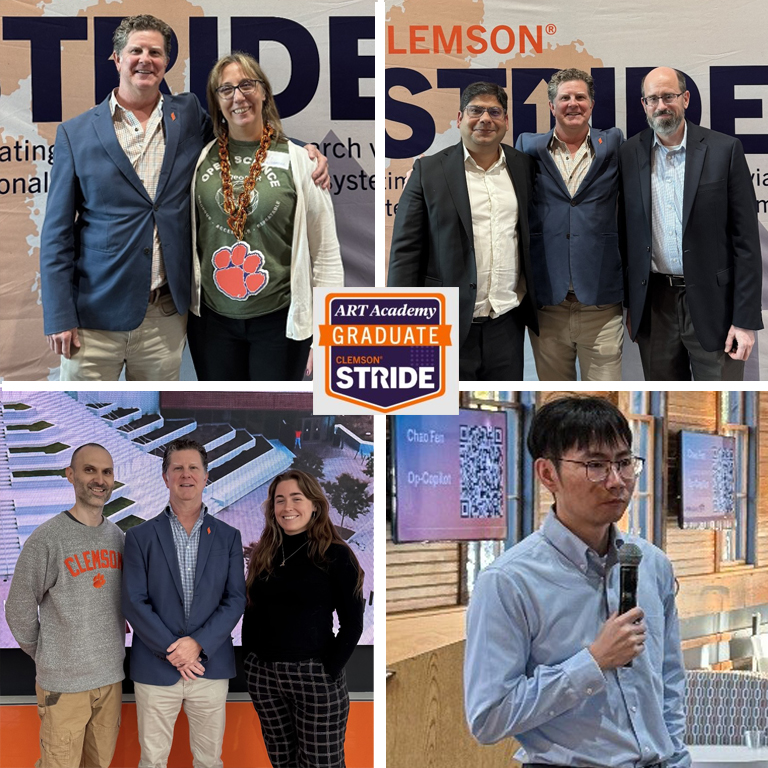
First place — Katherine Weisensee (geoFOR), professor and director of Forensic Anthropology Lab. Weisensee’s project introduced a forensic technology application for estimating the time of death using geospatial data and machine learning.
Second place — Anurag Chaturvedi, post-doctoral fellow at the Center for Human Genetics, and John Poole, bioinformatician/programmer at the Center for Human Genetics (Fly2Pharma)
Chaturvedi and Poole presented their research on advanced Drosophila research methods, working with the small genus of fly to get molecules to medicines faster.
Third place — Alexis Stamatikos, associate professor of Food, Nutrition, and Packaging Sciences, and Ally Brawner, graduate research assistant in Food, Nutrition, and Packaging Sciences (Innovative Cardiovascular)
Stamatikos and Brawner’s project, Innovative Cardiovascular, focuses on using endogenous, “natural” nanoparticles for treating cardiovascular disease.
Runner-up — Chao Fan, assistant professor of Civil Engineering and assistant professor of Environmental Engineering and Earth Sciences (Op-Copilot)
Fan’s research focuses on using agentic AI solutions for high-stakes emergency operations.
Applications for the STRIDE ART Academy Spring 2026 cohort will be available soon.