




Fritz Hollings earns Krause leadership award
March 21, 2016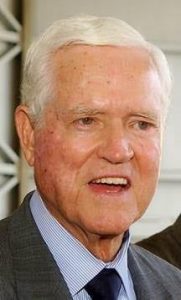
CHARLESTON, SC – From The Citadel in the 1940s, to the battlefields of World War II, to the office of Governor of South Carolina, and then the U.S. Senate, Ernest Frederick (Fritz) Hollings, has embodied the definition of leadership. For his service to the United States of America, to his fellow citizens, his fellow soldiers and his alma mater, Fritz Hollings was named as the recipient of one of The Citadel’s most prestigious awards, the Krause Center Award for Distinguished Service, Leadership, and Ethics, during the 9th Annual Principled Leadership Symposium on campus. The award was accepted on his behalf by the Honorable Patrick Michael Duffy, The Citadel Class of 1965, Senior U.S. District Court Judge. Hollings provided a statement about the recognition.
“This is a true honor and I am deeply grateful,” Hollings said. “My years at The Citadel were formative and of crucial importance to my years of public service. I’m proud, as my late friend Pat Conroy said, to wear the ring.”
Hollings was nominated for the award by the Dean of The Citadel School of Humanities and Social Services, Winfred (Bo) Moore, Jr.
“Senator Hollings has exemplified the courageous and principled leadership in service to others that the Krause Center for Leadership and Ethics seeks to make more common in American life,” said Moore.
 Hollings (pictured left as a cadet in 1942) graduated from The Citadel in 1942 with a bachelor’s degree in political science. Upon graduation he was commissioned as an artillery officer in the U.S. Army where he served for the next three years in North African and European theaters of operation. He was awarded one Bronze Star Medal and five Bronze Service Stars for his actions during World War II. After leaving active military duty, Hollings earned a law degree from the University of South Carolina and embarked on a career of service in public office that would last 58 years.
Hollings was elected to three terms as a representative to the South Carolina General Assembly where he authored a major anti-lynching bill and spearheaded an effort to finance improvements in public education. He became lieutenant governor in 1954 and was elected governor in 1958 at the age of 36.
During his time as governor, Hollings championed increases in teacher salaries, helped pioneer the establishment of technical colleges, and led the state during court-ordered desegregation of public schools with an impassioned call for peaceful compliance ─ a stance which put him in marked contrast to other Southern governors of that era who were calling for defiance.
Hollings was elected to the U.S. Senate in 1966 where he served for the next 38 years, becoming one of the most powerful shaping forces on American tax and trade policies in the 20th century. He worked to eliminate extreme levels of poverty on the sea islands of South Carolina in the late 1960s and provided testimony from his book, The Case Against Hunger, before Congress, which led to a national pilot program to distribute food stamps to Americans who had documented cases of need. He also consistently advocated for a strong national defense, but one with restraint in the use of force.
Hollings retired from the Senate in 2005 but remained active in public affairs. The Medical University of South Carolina named its cancer center, the Hollings Center for Cancer Research, after him to honor his many contributions. Most recently, Hollings campaigned successfully to have the federal judicial center in Charleston that had been named in his honor, to be renamed in honor of Judge J. Waties Waring, the Charlestonian whose landmark opinions on behalf of racial justice during the 1940s and 1950s paved the way for the U.S. Supreme Court’s desegregation decision in the case of Brown vs. the Board of Education of Topeka.
The Krause Center Award is presented annually to a Citadel graduate who exemplifies the highest ideals of leadership through integrity and service to others.