


From Clinton to Harvard: Presbyterian College alumna Dr. Jada Suber ’15 encourages Clinton High students to dream beyond limits
October 29, 2025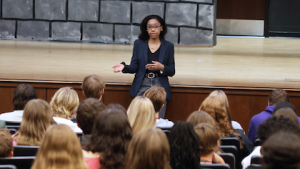
2025 Outstanding Alumna addresses students at her hometown alma mater
When Dr. Jada Suber graduated from Clinton High School in 2011, her world felt comfortably small. College was right down the road at Presbyterian College, and that was exactly how she liked it. She even joked that her original reason for choosing PC was because she was afraid to drive.
“I thought I could just get dropped off in front of PC and never have to drive anywhere,” she laughed. “But my mom didn’t let that happen, so I had to get over that real fast.”
Fourteen years later, Suber has expanded her world well beyond Clinton — and well beyond South Carolina. Now a postdoctoral research fellow at Harvard Medical School’s Brigham and Women’s Hospital in Boston, she is conducting cutting-edge research on food allergies, a lifelong personal passion that began when she was a child navigating school lunch tables with a long list of allergies.
Earlier this month, she returned to her alma mater to speak to Clinton High School’s science students about her journey — one that began in the same hallways where they now walk — and how perseverance, curiosity, and courage can carry anyone far beyond the limits of their hometown.
“Anything Is Possible”
Standing before the students in the same building where she earned her diploma, Suber opened with laughter and humility. “My class was the first to graduate out of this building,” she said, smiling. “That makes me feel a little old — but y’all better not call me old.”
The room quickly warmed to her relaxed, conversational tone. The message that followed was both simple and profound: anything is possible.
In fact, Suber reminded them that her high school capstone project was a children’s book she wrote titled Anything Is Possible.
“I really believe that,” she told them. “There’s nothing you can’t do. It might not always feel that way, but you have to be willing to never give up on your dream.”
Suber shared that she once dreamed of becoming a pediatrician and even led the pre-med club at PC. But while participating in a summer research program at the Medical University of South Carolina, she discovered her real calling: scientific research.
Her mentor at MUSC encouraged her to consider a Ph.D., an idea she initially rejected.
“I was offended,” she said with a grin. “I told him I wanted to be an M.D., not a Ph.D.! But he got under my skin — and eventually, he got through to me.”
When she realized that research could allow her to help people with food allergies on a global scale, she embraced a new path. She applied to graduate school — and didn’t get in.
“It was devastating,” she admitted. “But looking back, that ‘no’ was probably the best thing that ever happened to me. It pushed me toward immunology, and it opened doors I never even knew existed.”
Finding Purpose Through Science
After completing a one-year postbaccalaureate program that helped her transition from chemistry to immunology, Suber was accepted into the Ph.D. program in microbiology and immunology at the University of North Carolina at Chapel Hill. There, she began studying the cells that cause allergic reactions — and realized that she was exactly where she was meant to be.
At UNC, she spent years in the lab studying mast cells, immune cells that play a major role in allergic responses.
“When people have an allergic reaction, those cells basically ‘throw up,’” she explained, drawing laughter from the students. “It’s gross, but that’s how you remember it.”
Her research eventually brought her to Boston, where she now works at Brigham and Women’s Hospital, part of Harvard Medical School.
“When I first got there, they weren’t studying food allergies,” she said. “I told them, ‘I’m here to make y’all do food allergy research.’ And now we are — because of me.”
Suber said that moment — being able to shape the direction of her field — is one of her proudest achievements.
“It’s surreal to realize I’m doing the thing I dreamed about in eighth grade,” she said. “I wrote that I wanted to win a Nobel Prize for finding a cure for food allergies. I didn’t even know what that meant then. But here I am, working toward it.”
Lessons from Clinton
Throughout her talk, Suber made sure to credit her roots. She spoke affectionately about her Clinton High teachers, especially the late chemistry teacher Kenneth Hastings and biology teacher Henry Mack.
“I still talk about Mr. Mack’s shenanigans to this day,” she said, recalling the time he tore apart a DNA model after a student gave a wrong answer. “It scarred me — but it also taught me that people here have high expectations. And that’s carried me everywhere I’ve gone.”
She told students that growing up in Clinton and going to PC gave her a foundation of confidence and community that prepared her for the world.
“The type of support I felt here and at PC is unmatched,” she said. “You go to big places, and people might be nice, but nobody supports you like people here do.”
That sense of belonging, she said, sustained her through the hardest moments of graduate school.
“There were times when I didn’t feel supported where I was,” she admitted. “But I was okay, because I knew that the people back home believed in me.”
Building Support Systems and Taking Chances
Suber encouraged students to start building support systems of their own — with teachers, coaches, and mentors who can help them find their paths.
“Learning how to seek out mentors is one of the most important skills you can have,” she said. “Sometimes, you have to talk yourself into it. Just walk up and say, ‘Hi, my name is so-and-so, and I really liked what you said.’ It gets easier every time you do it.”
That advice comes from experience. It was a spontaneous conversation at a professional conference that eventually led her to Harvard. After presenting her research at a food allergy conference, she struck up a conversation with a physician who later invited her to apply for a postdoctoral position.
“I thought he was just being nice,” she said. “But he wasn’t. A few months later, I sent him an email — and that’s how I ended up at Harvard.”
She smiled as she recounted how surreal it felt to be “recruited” by one of the world’s leading research institutions. “It was kind of an accident,” she said. “But it was also destiny.”
Staying Grounded
Life in Boston, Suber told the students, is vastly different from life in Clinton.
“The rent is ridiculous,” she said, laughing. “My rent is around $2,700 a month — and that’s being nice. I definitely miss small-town living.”
But she’s proud of how far she’s come.
“People there ask where my accent’s from, and I tell them Clinton, South Carolina,” she said. “I used to be self-conscious about it, but now I wear it like a badge. I’m proud of where I came from.”
Suber also reminded the students to balance ambition with self-care. A self-described “creative scientist,” she still writes, draws, takes photos, and thrifts to stay grounded.
“Science gets on my nerves on Sundays,” she said with a grin. “So, I make sure to do the things I love. It keeps me balanced.”
“It Starts Here”
As she concluded her talk, Suber grew reflective. “Coming from a small town doesn’t hold you back,” she said. “The only thing that holds you back is thinking you can’t get out.”
She paused, scanning the faces of the students sitting where she once sat.
“I want you to remember that you can,” she said. “I came from here. I was just like you. I was scared to drive, scared to fly, scared to leave the state. But every time I pushed past one fear, a whole new world opened up. And it all started right here.”
The next day, Presbyterian College honored Dr. Suber as its 2025 Outstanding Young Alumna — an award recognizing alumni who have made exceptional contributions early in their careers.
But to the Clinton High students who heard her speak, her message carried a different kind of honor: the proof that one of their own had turned big dreams into real possibilities — and that maybe, they could too.