








Learn what soldiers ate during the American Revolution
November 11, 2025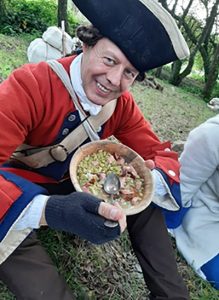
Most of us are looking forward to a fine feast on the 27th of this month – turkey and all the trimmings. That’s our way of celebrating something that happened in 1621.
But what would we be planning to eat if we had been soldiers – on either side – fighting our nation’s Revolutionary War a mere 250 years ago?
Kim Stacy, an enthusiastic student of the Revolution, will tell about those soldiers’ diets in a free lecture at noon on Friday, Nov. 21, at the Cayce-West Columbia Branch of Lexington County Public Library at 1500 Augusta Road in West Columbia. The program, “What Revolutionary Soldiers Ate,” is part of the South Carolina Confederate Relic Room and Military Museum’s regular Noon Debrief program, and the public is invited.
Stacy spoke at the library in another Noon Debrief on May 30 about the Battle of Camden, showing up in a British redcoat uniform. He’s likely to be attired that way again, but plans to speak about what was on the menu for both sides. And, if he doesn’t eat it all on the long march to West Columbia from his home in Camden, he might bring some samples of what soldiers ate during our founding conflict.
The armies of the 18th century had no MREs, K rations or other factory-packaged meals. Here’s a typical example of a soldier’s rations at the time, assuming his unit hadn’t run out of supplies:
• Flour, one pound or bread, or one pint Indian Meal.
• Peas, 3/7 of a pint or beans
• Pork, ½ pound, or one pound of either beef or salted fish
• Butter, 6/7 of an ounce or 8 oz cheese
• Oatmeal, 1 1/7 of an ounce, or 1 ounce of rice,
• Milk, one pint (American)
• Beer or cider, one quart
• Molasses, one ounce
• Rum or whiskey, one gill (4 oz.)
Soldiers would supplement the above with “whatever they could buy or steal,” Stacy adds. Corn was popular, and so were sweet potatoes, which could stay edible in the ground for a long time. The Battle of Eutaw Springs in South Carolina started when British soldiers foraging for sweet potatoes ran into some American troops unexpectedly.
“Both armies came in like a plague of locusts,” wherever they went, says Stacy.
But for the better-supplied Brits, about 70 percent was shipped over from England, and then stored in warehouses in such port cities as Savannah, Charleston, Boston, Wilmington, and New York. A lot of that took the form of “hardtack,” a plain, durable cracker made of flour and water.
Americans also had some food depots in inland locations, such as Lancaster, Penn. But none in South Carolina.
As Napoleon would supposedly later say, an Army marches on its stomach. Come learn what the armies who fought in the Revolution ate to keep themselves marching across the original 13 states.
About the South Carolina Confederate Relic Room and Military Museum
Founded in 1896, the South Carolina Confederate Relic Room and Military Museum is an accredited museum focusing on South Carolina’s distinguished martial tradition through the Revolutionary War, Mexican War, Civil War, Spanish-American War, World Wars I and II, Vietnam, the War on Terror, and other American conflicts. It serves as the state’s military history museum by collecting, preserving, and exhibiting South Carolina’s military heritage from the colonial era to the present, and by providing superior educational experiences and programming. It recently opened a major new exhibit, “A War With No Front Lines: South Carolina and the Vietnam War, 1965-1973.” The museum is located at 301 Gervais St. in Columbia, sharing the Columbia Mills building with the State Museum. For more information, go to https://crr.sc.gov/.