



Matt Navarro ’99 Urges Presbyterian College Students to Lead with Vision, Values at Vance Lecture
February 17, 2026
Stanley 1913 global president tells students that ethics, culture, and clarity of purpose drive lasting success.
When Matt Navarro ’99 stood before students in Edmunds Hall for Presbyterian College’s annual Robert M. Vance Lecture on Business Ethics, he did not begin with viral tumblers, celebrity partnerships or record-breaking revenue.
He began with a question.
“Do you know who you are?” Navarro asked.
For the global president of PMI WW Brands, LLC — parent company of Stanley 1913 — that question sits at the heart of leadership. And last Thursday, Navarro urged students to define their values before defining their careers.
From ‘average student ‘ to global CEO
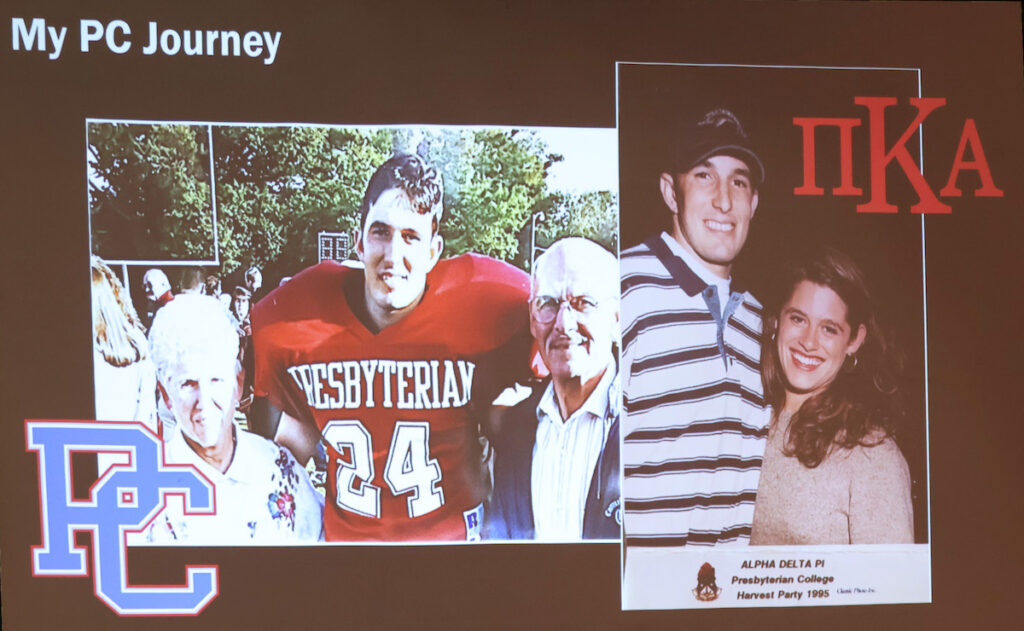
Navarro returned to campus nearly 27 years after graduating, describing himself as “a very average student” who loved college life and athletics but did not have a master plan.
“I had no idea what I wanted to do when I was 18, 19 years old sitting in this auditorium like you guys,” he said.
A former member of the football team and Pi Kappa Alpha fraternity, Navarro credited his liberal arts education with giving him broad exposure and teaching him to listen to different perspectives.
“You’re not supposed to know exactly what you want to do,” he said. “Be curious. Take a lot of different classes. Ask questions. And have a lot of fun.”
Navarro initially planned to pursue education and coaching before pivoting into business. Early in his career, a mentor challenged him to choose between leading a business unit or leading people and organizations. He chose leadership.
“I want to build high-performing teams,” he said. “I want to find the right leaders. I want to grow and develop as a leader.”
That focus would shape a career that included leadership roles with brands such as Wilson, Salomon and Arc’teryx before he joined Stanley in 2020.
Ethics in action
Navarro told students that one of the most pivotal moments in his career came when he decided to leave a previous employer after it was acquired by a private equity firm.
“When you’re sitting in rooms and the decisions being made just don’t align with your values,” he said, “I think it’s probably time to go.”
For Navarro, ethics is not theoretical. It is practical and personal.
He described vision as a company’s “why,” mission as its “how,” and values as the foundation for how people treat one another and make decisions.
“Your values are your guiding light,” he said. “They’re your north star.”
At Stanley, Navarro helped refresh the company’s vision, mission and values, engaging employees across the globe in the process. Those principles guide decisions ranging from product development to sourcing and sustainability.
The 112-year-old brand has experienced dramatic growth in recent years, fueled in part by the popularity of its colorful Quencher tumblers. Annual sales climbed from roughly $70 million in 2019 to an estimated $750 million by 2023.
But Navarro emphasized that long-term success depends on more than trend-driven demand.
“Do you know who you are? Do you know where you’re going? Do you know how you’re going to get there? And can you execute?” he said. “All successful companies have clarity around those questions.”
Culture as competitive advantage
Navarro argued that culture — often difficult to define — is one of the strongest competitive advantages an organization can possess.
“Culture is how you make people feel,” he said. “It’s how people feel about being part of something.”
He said his top priority as CEO is creating an environment where employees at every level can perform at their best.
“Have we created a culture where from intern to C-level executive, people are able and motivated to be at their best?” he asked. “If everybody’s in that situation, it’s endless what teams and companies can accomplish.”
He encouraged students to look beyond salary and job titles when entering the workforce and to evaluate leadership behavior and organizational values.
“People leave bosses, not companies,” Navarro said. “Find somebody you want to work for.”
He also advised students to build a “personal board of directors” — trusted mentors and advisors who provide honest feedback and diverse perspectives during major life decisions.
Know who you are. Let your values guide your decisions. Everything else takes care of itself.”
Matt Navarro ’99
Sustainability and responsibility
Navarro highlighted Stanley’s efforts in sustainability and social impact, including using recycled materials in products, reducing emissions and partnering only with “grade A” factories that meet ethical labor standards.
“Ask companies what they’re really doing,” he told students. “Not just what’s on the PowerPoint slide.”
He described an ongoing debate within the company about how prominently to market sustainability initiatives — balancing transparency with the risk of “greenwashing,” or overstating environmental efforts.
“Sometimes the right thing to do is just do the right thing,” he said. “If people care and they’re paying attention, they’ll see it.”
Stanley’s community engagement includes volunteer initiatives and its Creators Fund, which supports emerging businesses focused on sustainability and social impact.
“We’re feeding people in communities that otherwise wouldn’t eat,” Navarro said. “That’s the stuff that really makes you feel good about what you’re doing.”
Lessons in leadership
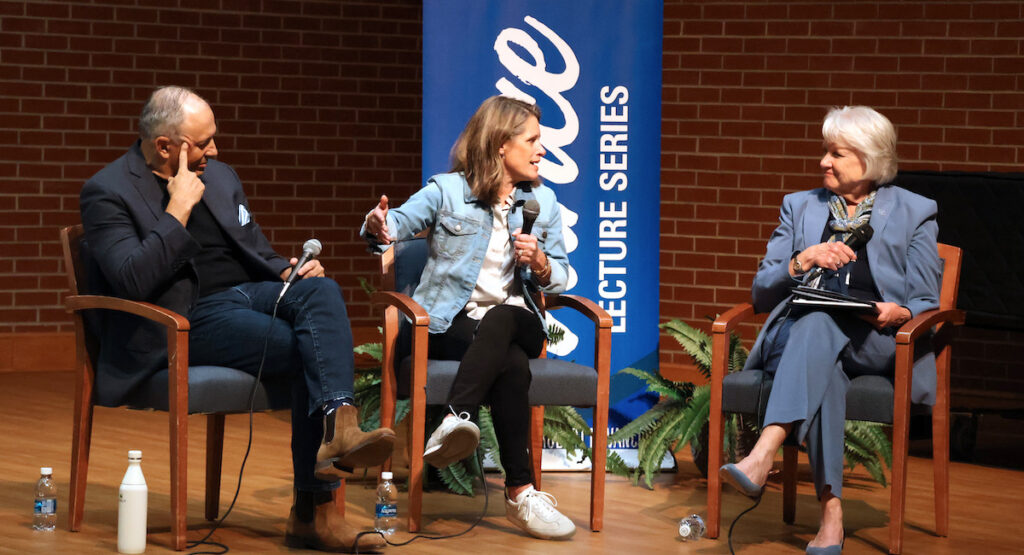
During a question-and-answer session, students pressed Navarro about mistakes, leadership growth and evaluating workplace culture.
He acknowledged that some of his most difficult lessons involved hiring decisions.
“The mistakes that aren’t fast and cheap — those are painful,” he said. “Most of the time when I’ve missed, it’s because I led with my head and not my heart.”
Navarro said his leadership style has evolved over time, particularly in delivering feedback.
“You’re doing people a disservice if you don’t tell them,” he said. “I move faster on feedback now, even when it’s hard.”
He told students that company culture often reveals itself during adversity rather than during periods of rapid growth.
“When things are going great, culture feels easy,” he said. “It’s in adversity that your values really show up.”
A shared foundation
Navarro’s visit to campus also marked a return with his wife, Carolyn, whom he met while they were students at Presbyterian College. Carolyn later returned to school to pursue nursing, becoming a registered nurse at age 50 — a story Navarro cited as an example of lifelong growth and perseverance.
“Life’s about moments,” Navarro said. “Life’s about relationships.”
As he closed his remarks, Navarro expressed gratitude for his education and encouraged students to embrace both opportunity and uncertainty.
“Take some chances,” he said. “It’s not always a straight line.”
The Robert M. Vance Lecture Series on Business Ethics is funded by a gift from the Bailey Foundation and named for the late Robert M. Vance, a Clinton businessman and former PC trustee who valued ethics, honesty and integrity in business.
For Navarro, those principles remain central to leadership.
“Know who you are,” he told students. “Let your values guide your decisions. Everything else takes care of itself.”