



McMaster Delivers Final State of the State, Outlines Vision for “The South Carolina Century”
January 28, 2026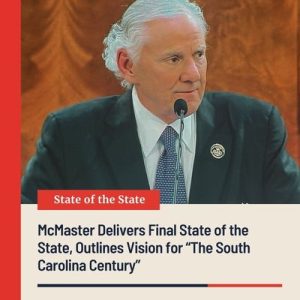
Gov. Henry McMaster delivered his final State of the State address Wednesday, Jan. 28, 2026, offering a broad vision for South Carolina’s future while reflecting on progress made during his time in office. While State of the State addresses traditionally cover a wide range of topics, the scope of McMaster’s remarks — and their potential long-term impact — makes a detailed summary important for understanding the direction he hopes the state will continue to follow.
McMaster closed out a historic tenure that began when he assumed office on January 24, 2017, following then-Gov. Nikki Haley’s resignation. He later won full terms in 2018 and 2022, and in January 2025 became the longest-serving governor in South Carolina history.
Speaking before members of the General Assembly, state leaders, and invited guests at the South Carolina Statehouse, McMaster opened his final address by honoring four South Carolina first responders who lost their lives in the line of duty in 2025, offering condolences to their families and gratitude for their service.
Throughout the speech, McMaster framed South Carolina as a state defined by “commerce, conservation and consequence,” emphasizing that economic strength, educational excellence, and environmental stewardship must work together to secure long-term prosperity.
Economic growth and business investment
The governor pointed to continued economic momentum as a hallmark of his administration. In 2025 alone, he said, South Carolina announced more than $9.1 billion in new capital investment and over 8,100 new jobs across both rural and urban communities.
Among the companies highlighted were major manufacturing and industrial projects in counties including Allendale, Pickens, Clarendon, Greenville, and Spartanburg. Since 2017, McMaster said the state has seen more than $53.7 billion in new investment and nearly 100,000 new jobs.
He credited the growth to what he described as strong fiscal management, business-friendly policies, and ongoing income tax reductions. The governor again urged lawmakers to continue lowering the state’s personal income tax rate, saying he would sign further reductions “as fast as we can,” and even support full elimination if lawmakers find a way to do so.
At the same time, McMaster warned that rapid population growth is placing new strain on infrastructure and public services. He called for a close look at whether roads, utilities, schools, healthcare systems, and law enforcement resources can keep pace with continued in-migration.
Infrastructure and energy
On infrastructure, the governor noted that active road and bridge projects across the state now total nearly $7 billion, up significantly from 2017. However, he said inflation in construction and labor costs threatens to slow progress and asked the General Assembly to invest an additional $1.1 billion in surplus funds to keep projects on track.
Energy capacity was another major focus. McMaster highlighted South Carolina’s role in what he described as a national “nuclear renaissance,” pointing to the state’s existing reactors and plans to restart construction on unfinished nuclear units at the V.C. Summer site. He said reliable, affordable energy will be essential for continued economic development and technological growth.
Education investments
Education remained central to the governor’s vision for the state’s future workforce. He emphasized continued increases in teacher pay, noting that the minimum starting teacher salary has risen from just over $30,000 eight years ago to a proposed $50,500 this year. He said the average teacher salary now exceeds the Southeastern average.
McMaster also promoted the expansion of full-day four-year-old kindergarten (4K) programs, reporting that more than 18,000 students are currently enrolled, a 30 percent increase since the program was expanded statewide. He urged lawmakers to move toward universal full-day 4K regardless of household income.
School safety was another area he highlighted. The governor said every public school in South Carolina now has funding for a school resource officer, with nearly all campuses staffed. He shared a recent incident in Chester County in which school resource officers intervened during an attempted child abduction, crediting their presence with preventing a tragedy.
Higher education and workforce training
Higher education and workforce training also received attention, with McMaster noting continued tuition freezes for in-state students at public colleges and expanded scholarships for technical college training in high-demand fields.
Mental health and government restructuring
The governor also addressed what he described as one of the most significant government restructuring efforts in decades — an overhaul of how South Carolina delivers mental health, disability, and public health services — and how those changes directly affect law enforcement officers and first responders across the state.
McMaster said the state’s previous system was highly fragmented, with multiple agencies operating in silos and families often forced to navigate a confusing maze of offices when seeking help for loved ones with mental health challenges, disabilities, or substance use disorders. As a result, many individuals in crisis ended up interacting first with law enforcement rather than receiving early treatment through the healthcare system.
He noted that in recent years a large percentage of young people experiencing major depressive episodes were not receiving treatment, while suicides, untreated addiction, and homelessness tied to mental illness had become growing concerns. Those gaps, he said, have placed increasing strain on local law enforcement agencies, emergency medical services, and hospital emergency departments, which are often left to respond when mental health needs go unmet.
In response, the state conducted a comprehensive review of its behavioral health and human services system, which led to a sweeping restructuring designed to improve coordination, accountability, and leadership.
Over the past two years, several longtime agencies were dissolved and reformed into new cabinet-level departments under direct gubernatorial oversight. The former Department of Health and Environmental Control was divided into the Department of Public Health and the Department of Environmental Services. More recently, the Department of Mental Health, the Department of Disabilities and Special Needs, and the Department of Alcohol and Other Drug Abuse Services were consolidated into a new Department of Behavioral Health and Developmental Disabilities.
McMaster said the goal of the changes is to reduce duplication, streamline services, and make it easier for families to access care before situations escalate into emergencies. He told lawmakers the new agencies are now collaborating more closely, improving communication, and working to ensure that individuals in crisis are connected with treatment and long-term support — not just temporary intervention through the criminal justice system.
While acknowledging that South Carolina still faces serious challenges in mental health care, the governor said he believes the most difficult phase of the restructuring is behind them and that the new system will help relieve pressure on law enforcement officers and first responders who too often serve on the front lines of the state’s mental health crisis.
Public safety and the courts
Public safety was another key theme. The governor highlighted pay raises for law enforcement officers and corrections staff, investments in equipment and training, and what he described as progress in reducing recidivism.
He also called for changes to the way judges are selected in South Carolina, arguing that the current legislative-driven system should be replaced with a model more familiar to the public. McMaster proposed that judges be appointed by the governor with the advice and consent of the state Senate, similar to the federal system, saying such a structure would increase transparency, accountability, and public confidence in the judiciary.
South Carolina is one of only two states where the legislature plays the primary role in selecting judges. While acknowledging recent legislative steps to improve the process, McMaster said those changes were only a beginning and that more comprehensive reform is needed to ensure the public trusts how members of the judiciary are chosen. He added that a clearer, more open appointment process could also encourage more highly qualified attorneys to pursue judicial service.
The governor also proposed reforms to the state’s magistrate court system, which handles the vast majority of everyday court cases across South Carolina. Currently, magistrates are appointed by the governor but funded at the county level, resulting in wide disparities in pay from one county to another. McMaster said that structure creates inequities and makes it difficult to attract and retain qualified candidates.
He suggested magistrates should be paid by the state, similar to circuit and appellate court judges, to ensure consistent compensation. He also called for a requirement that magistrates be licensed attorneys, noting that many currently are not, and for the elimination of county residency requirements that can limit the pool of applicants. In addition, he proposed that the Chief Justice of the South Carolina Supreme Court have greater authority over the operation of magistrate courts statewide to promote uniform standards and procedures across all 46 counties.
Conservation and resilience
McMaster devoted a significant portion of his speech to conservation and environmental protection, arguing that economic growth and land preservation are not competing interests but complementary goals that strengthen South Carolina’s long-term prosperity and quality of life.
He highlighted the protection of nearly 400,000 acres of historically and environmentally significant land over the past decade, describing it as one of the largest sustained conservation efforts in state history. These efforts have included working farms and forests, African American historic sites, wildlife habitats, and land that will provide new public recreation opportunities from the Upstate to the coast.
The governor credited partnerships among state agencies, nonprofit conservation groups, private landowners, and local governments for making those protections possible. He specifically noted the role of the South Carolina Conservation Land Bank, which has leveraged state funding with federal, local, and private dollars to preserve large tracts of land, including one of the largest conservation easements in state history in the Pee Dee region.
McMaster also pointed to the expansion of state parks and natural areas, including the creation of new parks and the growth of existing ones, giving residents and visitors more access to South Carolina’s rivers, forests, and green spaces.
Resilience — particularly in the face of flooding and severe weather — was another major focus. The governor highlighted the creation of the state’s Office of Resilience and the appointment of a Chief Resilience Officer to lead flood mitigation, disaster recovery, and long-term planning efforts. These initiatives include voluntary home buyout programs in flood-prone areas, investments in drainage and stormwater projects, and studies to better understand and reduce flood risk statewide.
Water planning also featured prominently in his remarks. McMaster noted the recent completion of the state’s first updated comprehensive Water Plan in more than two decades. The plan is designed to provide a clearer inventory of South Carolina’s surface and groundwater resources and to guide decisions about future water use as the state continues to grow.
Taken together, the governor said, these conservation and resilience efforts are aimed at ensuring that South Carolina’s natural beauty, working lands, and water resources remain protected for future generations while still supporting responsible economic development.
Looking ahead
Returning to a question he said he first posed several years ago — what South Carolina will look like in 100 years — McMaster used the closing portion of his speech to paint a sweeping vision of the state’s future.
He described towns and cities filled with thriving families, where children are happy, healthy, and eagerly soaking up knowledge from well-supported teachers in strong schools. He spoke of young people equipped with the education, confidence, and skills needed to pursue careers across a diverse economy, from advanced manufacturing and medicine to agriculture, aerospace, the arts, and technology.
McMaster said he envisions parents building stable futures in communities supported by good jobs, safe neighborhoods, and reliable infrastructure, with opportunity available in both rural and urban areas.
Just as central to that vision, he said, are South Carolina’s natural landscapes — the Blue Ridge Mountains, rivers and lakes, forests and farmland, marshes and beaches — preserved and protected even as the state grows. He described those lands and waters as gifts that must be cared for and passed along to future generations.
As he looked toward that future, McMaster described South Carolina as a “land of leaders,” pointing to the state’s long history of producing leaders in government, the military, industry, education, and community life. He said that legacy, built over generations, is something today’s South Carolinians are called to continue.
He reminded lawmakers and citizens alike that government cannot — and should not — do everything. Instead, he said, strong families, engaged communities, faith institutions, businesses, and civic organizations must work alongside government to meet the needs of the state.
Leadership, he suggested, is not limited to elected office but is found in parents raising children, teachers shaping young minds, business owners creating jobs, first responders serving their communities, and volunteers stepping up to help neighbors in times of need.
Framing the moment as one of rare opportunity, McMaster said South Carolina stands at a point where strong economic momentum, population growth, and long-term planning could define the state’s trajectory for generations.
He closed by urging state leaders to remain bold, collaborative, and forward-thinking, saying the decisions made today will shape what South Carolina looks like for generations to come.
“The best is yet to come,” McMaster said, ending his final State of the State address with a message of optimism for the Palmetto State.
SOCIAL LINKS






Categories
- Accounting
- Advice
- Architecture
- Banking and Finance
- Business Services
- Commercial Real Estate
- Construction
- Conversations
- Economic Development
- Education
- Employment
- Energy
- Engineering
- Entertainment
- Entrepreneurship
- Environmental
- Festivals & Special Events
- Financial Advisors
- Food
- Government
- Headlines
- Health & Wellness
- Health Care Providers
- Hi-Tech/ Information Tech
- Hospitality
- Insurance
- Law
- Life
- Manufacturing
- Marketing and Communications
- Military
- Non Profit
- Op-Ed
- Philanthropy
- Podcast
- Public Safety
- Residential Real Estate
- Restaurant
- Retail
- Sports
- Technology
- The Arts
- Transportation

SOCIAL LINKS

Categories
- Accounting
- Advice
- Architecture
- Banking and Finance
- Business Services
- Commercial Real Estate
- Construction
- Conversations
- Economic Development
- Education
- Employment
- Energy
- Engineering
- Entertainment
- Entrepreneurship
- Environmental
- Festivals & Special Events
- Financial Advisors
- Food
- Government
- Headlines
- Health & Wellness
- Health Care Providers
- Hi-Tech/ Information Tech
- Hospitality
- Insurance
- Law
- Life
- Manufacturing
- Marketing and Communications
- Military
- Non Profit
- Op-Ed
- Philanthropy
- Podcast
- Public Safety
- Residential Real Estate
- Restaurant
- Retail
- Sports
- Technology
- The Arts
- Transportation
Follow us


Categories
- Advice
- Agriculture
- Chamber
- Echoes & Insights
- Economic Development
- Education
- Employment
- Entertainment
- Environmental
- Festivals & Special Events
- Government
- Health & Wellness
- Health Care Providers
- Hospitality
- Laurens County Sports
- Law
- Local Industry
- Manufacturing
- Marketing and Communications
- Music
- Non Profit
- Public Safety
- Social Scene
- The Arts
- Veterans


Categories
- Accounting
- Advice
- Agriculture
- Architecture
- Banking and Finance
- Business Services
- Chamber
- Churches
- Commercial Real Estate
- Construction
- Conversations
- Economic Development
- Education
- Employment
- Energy
- Entertainment
- Entrepreneurship
- Environmental
- Festivals & Special Events
- Financial Advisors
- Government
- Headlines
- Health & Wellness
- Health Care Providers
- Hi-Tech/ Information Tech
- Home Remodel/ Maintenance
- Hospitality
- Hotels
- Insurance
- Law
- Life
- Local Industry
- Manufacturing
- Marketing and Communications
- Military
- Music
- Non Profit
- Op-Ed
- Philanthropy
- Podcast
- Politics
- Public Safety
- Residential Real Estate
- Restaurant
- Retail
- Social Scene
- Sports
- Telecommunications
- The Arts
- Transportation
- Utilities


Categories
- Advice
- Agriculture
- Chamber
- Echoes & Insights
- Economic Development
- Education
- Employment
- Entertainment
- Environmental
- Festivals & Special Events
- Government
- Health & Wellness
- Health Care Providers
- Hospitality
- Laurens County Sports
- Law
- Local Industry
- Manufacturing
- Marketing and Communications
- Music
- Non Profit
- Public Safety
- Social Scene
- The Arts
- Veterans