


Presbyterian College’s New Eco Hub Brings Composting and Community Together
November 9, 2025
Dr. Sabrina Moore secures grant to launch innovative recycling initiative on campus.
Presbyterian College is taking a major step toward sustainability with the launch of its new Eco Hub, a composting and recycling initiative led by Dr. Sabrina Moore, assistant professor of biology.
Backed by a nearly $10,000 grant from the South Carolina Department of Environmental Services, the Eco Hub is designed to transform waste into resources while engaging both students and the Clinton community in meaningful environmental action.
From Personal Passion to Campus Impact
For Moore, who teaches ecology at PC, the idea grew out of both personal practice and a sense of urgency after Hurricane Helene.
“I’ve always loved composting at home,” she said. “But during Helene, I felt a lot of eco grief. It made me stop and ask, ‘What can I do to make a difference for our campus and community?’”
The answer came in the form of composting. While PC needs stronger recycling infrastructure, Moore said composting represents the truest form of recycling.
“When you compost, you’re taking waste and turning it directly back into soil that can grow more plants,” she explained. “That’s recycling in its purest sense.”
Securing Support
Moore applied for a state grant with both recycling and composting in mind. The grant awarded PC just under $10,000, with $4,000 initially earmarked for composting bins. But thanks to a generous donation, the Eco Hub received a boost.
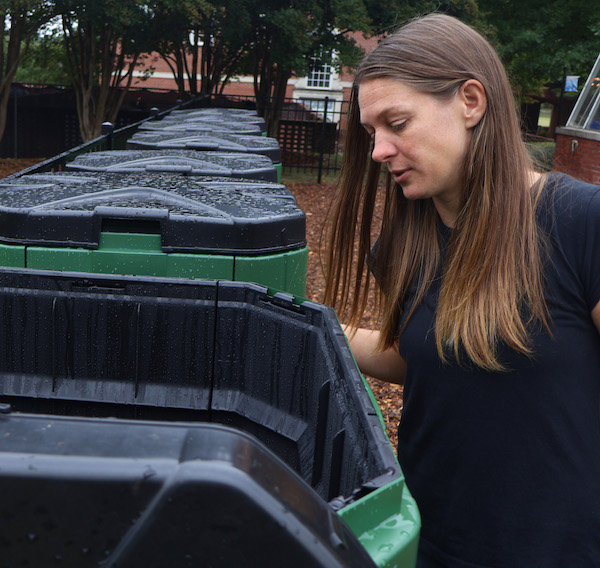
Moore contacted Aerobin, an Australian company that manufactures specialized composting systems, and explained the project. The company, along with its U.S. distributor, Exaco, agreed to donate eight 400-liter bins, saving thousands of dollars and allowing PC to expand the project.
“These Aerobin composters are incredible,” Moore said. “They don’t smell, they don’t require turning, and they can produce compost in as little as six months. They’re also the largest models available—and we got them for free.”
Building the Eco Hub
Moore envisions the Eco Hub as more than a composting station. She sees it as an outdoor learning and gathering space where students and community members can come together around sustainability.
The process is straightforward: cardboard and coffee grounds are layered in the bins with water, where airflow and microbial activity naturally break the material down. In about half a year, the bins will produce usable soil.
Already, the initiative has generated significant results. In just the first month of operation, PC collected more than 500 cardboard boxes and 100 pounds of coffee grounds. Much of that material has come from the AVI-managed Starbucks in Springs, where the team has enthusiastically contributed daily collections of cardboard and coffee.
“People are intrigued once they understand how it works,” Moore said. “They realize composting can be clean, efficient, and beneficial for the whole community.”
Community Partnerships
The soil generated from the Eco Hub will support both campus and community projects. Moore outlined several immediate uses:
- Clinton Community Garden Project – Moore, who serves on the board, will help use the compost to start plants and enrich raised bed soil.
- Coffee Plus Cardboard, a nonprofit partner that installs community and personal gardens for people in need.
- PC landscaping and pollinator gardens – The Ecology Club and other student groups will use compost to support native habitats and sustainable landscaping efforts.
- Eco Hub raised beds – Moore plans to establish flower and vegetable beds within the Eco Hub itself. Produce from the beds will be given away on Earth Day, and the flowers will support pollinators.
“This is really about bringing people together,” Moore said. “I want the Eco Hub to be a place where students, faculty, and community members can learn about composting, gardening, and sustainability in a hands-on way.”
This is really about bringing people together. I want the Eco Hub to be a place where students, faculty, and community members can learn about composting, gardening, and sustainability in a hands-on way.”
Dr. Sabrina Moore, Assistant Professor of Biology
Looking Ahead
The Eco Hub is on track to produce its first batch of soil by April, just in time for spring planting projects across campus and in the community. In the meantime, Moore is focused on education and engagement.
The project’s official grand opening is scheduled for Saturday, Nov. 8, with a “Recycle Your Pumpkin” community event. Timed just after Halloween, the event will invite local residents to bring their used pumpkins to the Eco Hub, smash them for compost, and learn more about how PC is turning waste into resources.
“It’s going to be fun, hands-on, and educational,” Moore said. “Smashing pumpkins is a great way to get people involved in composting—and it will give our bins a big boost of organic material.”
A Model for Sustainability
Moore sees the Eco Hub as part of a larger cultural shift on campus. She hopes the initiative will challenge misconceptions about composting as smelly or messy and instead showcase it as an efficient, science-based recycling solution.
“People sometimes think composting is just garbage rotting,” she said. “But when you do it correctly, it’s clean, it’s quick, and it creates something valuable.”
Her long-term vision includes expanding the Eco Hub’s raised beds, incorporating more community gardens, and making PC a regional leader in sustainable practices. With custom cardboard collection bins planned in January, the infrastructure is growing alongside awareness.
A Community Effort
Moore is quick to credit others for the Eco Hub’s early success. In addition to Aerobin’s donation, she points to the support of campus colleagues, students, and Starbucks staff as essential partners.
“We’ve already seen how much can be collected in just a month,” she said. “That’s because people are contributing every day. It really shows what’s possible when we work together.”
For Moore, the Eco Hub is more than just a project—it’s a hopeful step in the face of climate anxiety.
“After Helene, I needed to do something that mattered,” she reflected. “This is a way to turn grief into action. Composting may seem small, but it’s a real, tangible way to make a difference.”
With the Eco Hub taking root, PC is poised to transform its waste stream into fertile ground—literally and figuratively—for a more sustainable future.