



Understanding the Joro Spider: Clemson Expert Shares What Locals Need to Know
December 6, 2025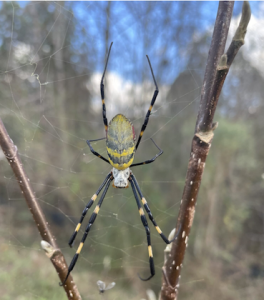
Content adapted from Clemson University’s Joro Spider Q&A, authored by Dave Coyle, Clemson Cooperative Extension.
As Joro spiders continue making headlines across the Southeast, Clemson University is helping residents separate fact from fear. In a recent Q&A article, Jaime with the Clemson Cooperative Extension offered a grounded look at these brightly-colored newcomers—spiders that are big, eye-catching, and often misunderstood.
Joro spiders, originally native to East Asia, have steadily spread through Georgia, South Carolina, North Carolina, and Tennessee over the past decade. Their large size and striking yellow-and-gray markings make them hard to miss, and their expansive orb-shaped webs often appear on porches, trees, and fences this time of year.
Despite their intimidating appearance, Clemson experts say there’s little reason for concern.
Not a threat to people or pets
According to Clemson’s Q&A, Joro spiders are not dangerous to humans or animals. Like most spiders, they can bite, but their fangs are small, bites are rare, and reactions—if they occur—tend to be mild.
“They’re big. They’re brightly colored. And they give a lot of people the creeps,” Jaime writes in the Clemson article. “But they’re not out to get you.”
Clemson notes that Joros prefer to stay outdoors and avoid human interaction. They are not aggressive and are far more interested in catching insects than bothering people.
Where they’re spreading
Joro spiders were first documented in the United States in Georgia more than a decade ago. Since then, they have moved north and west, taking advantage of suitable climate conditions. Much of the eastern United States may be hospitable to them in the long term.
Here in the Upstate, sightings increase in late summer and fall, when adults reach full size and begin constructing larger webs.
What about the environment?
Scientists are still studying the long-term ecological impact of Joro spiders. Some believe they may help reduce populations of nuisance insects. Others worry that they could compete with native spider species. Research is ongoing, and Clemson encourages residents to stay informed as new findings emerge.
For now, experts recommend simple management: removing webs with a broom if they’re in the way and avoiding unnecessary pesticide use.
Bottom line
Clemson’s guidance, shared through Jaime’s recent Q&A, urges residents to stay calm, stay curious, and avoid assuming the worst based on appearance alone. Joro spiders may be new to South Carolina, but the current science shows they’re far more startling than harmful.
To read the full Q&A from Clemson University, visit the Clemson Forestry & Environmental Conservation blog.
Photo credit: Dave Coyle