Fresh Mandates and Policy Shifts: What South Carolina’s July 1 Laws Mean for You
July 1, 2026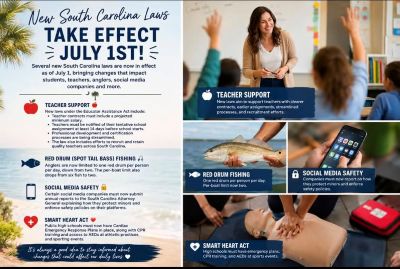
July 1 marks the start of a new fiscal year in South Carolina, bringing a wave of newly enacted legislation that directly reshapes public school safety, teacher licensing, community resource access, and outdoor recreation rules across the Palmetto State.
Rather than a single sweeping overhaul, this summer’s legislative rollout introduces distinct, practical changes that local residents, educators, and outdoor enthusiasts will notice immediately.
Classroom Care: The “Smart Heart Act” Takes Effect
Student-athlete safety is getting a significant upgrade under the newly implemented Smart Heart Act. Prompted by growing national awareness of sudden cardiac events in youth sports, the law mandates that every public school district and charter board establish a formalized Cardiac Emergency Response Plan (CERP).
The mandate goes beyond simply having a plan on paper:
-
AED Accessibility: Schools must ensure Automated External Defibrillators (AEDs) are not only functional but positioned within strict walking distance of athletic venues, games, and practice spaces.
-
Staff Preparation: Coaches and designated athletic staff are now required to maintain up-to-date training in CPR, basic first aid, and AED operation.
-
Emergency Drills: Much like traditional fire drills, schools will be expected to run practice protocols to prepare a school-level team for rapid response if a cardiac emergency occurs.
Supporting Educators: The Educator Assistance Act
In an effort to reduce the administrative burdens facing local teachers, the Educator Assistance Act introduces key structural updates to professional credentials.
Most notably, standard professional teaching certificates issued by the State Board of Education will now be permanent rather than requiring a periodic renewal process, provided the educator remains in good standing. Additionally, the act reshapes workplace flexibility by requiring local school boards to establish a sick leave bank, allowing teachers and staff to donate their unused leave to colleagues in need.
Streamlining Help: 211 Moves to Consumer Affairs
South Carolina’s primary helpline for individuals seeking assistance with housing, utility bills, food resources, and healthcare—the South Carolina 211 Network—has officially changed hands.
Formerly housed under the Budget and Control Board framework, oversight of the 211 hotline has been legally transferred to the S.C. Department of Consumer Affairs. The transition aims to optimize how the state monitors and analyzes local demographic needs, ensuring more data-driven, equitable distribution of human services across local counties.
Rules for the Great Outdoors: Hunting & Fishing Updates
For local anglers and hunters, the state’s wildlife regulations are shifting to protect coastal ecosystems and manage local game populations:
-
Red Drum Restrictions: New size and strict catch limits are being implemented to support red drum conservation.
-
Tackle Modifications: Anglers targeting specific coastal species will now be required to use nonoffset, nonstainless steel circle hooks under certain conditions to minimize severe injury to caught-and-released fish.
-
Deer Tags: To better manage the state’s wildlife density, the Department of Natural Resources is expanding the total number of authorized anterless deer tags issued to hunters for the upcoming season.
Professional Licensing Shift
Even specialized industries face changes this summer. Licensees operating under the state Board of Funeral Examiners must now comply with revamped continuing education rules. The updated guidelines tighten the definition of “physical attendance” for credentialing courses, establishing strict parameters for what qualifies as in-person instructional hours versus remote alternatives.