Move Over or Face the Consequences: Greenville County Deputy Theo King on South Carolina’s Move Over Law
July 12, 2026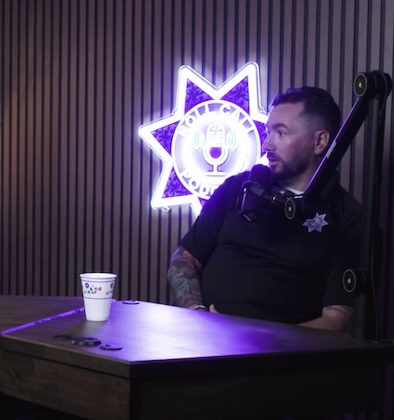
In last week’s episode of the Roll Call podcast, the Greenville County Sheriff’s Office sits down with Deputy Theo King to talk about South Carolina’s Move Over Law, the steep penalties drivers face for ignoring it and the split-second dangers of working just inches from moving traffic. For King, the subject is deeply personal. Days earlier, he lived through the very scenario the law is meant to prevent.
A Close Call That Could Have Ended in Tragedy
In the early morning hours of July 3, King was on Interstate 85 South protecting a tow operator who was loading a disabled vehicle onto a rollback. His cruiser was parked on the shoulder with its emergency lights flashing when another vehicle slammed into the back of it.
“I’m sitting there in the car just hanging out, and something told me, ‘Hey, you should look up,'” King recalled on the podcast. “I looked up, and in not even half a second, I saw headlights in my rear view. I felt the hit and then the next thing I knew, I was looking at the side of the tow truck.”
The force of the crash pinned King’s door shut. He had to kick it open to climb out and check on the tow operator, who was working beside the truck at the moment of impact. Everyone involved was taken to the hospital for treatment. King is expected to make a full recovery.
In the days that followed, King and the Greenville County Sheriff’s Office released dashcam footage of the crash as a public reminder of why the Move Over Law exists and what is at stake when drivers do not follow it.
What the Law Requires
South Carolina was among the first states in the nation to adopt a Move Over Law, first passed by the General Assembly in 1996. The law requires drivers approaching a stopped authorized emergency vehicle with its lights flashing to move over into a lane away from the vehicle when it is safe to do so. When changing lanes is not possible, drivers must slow down and pass with caution. Authorized vehicles include ambulances and police, fire, rescue, recovery and towing vehicles responding to a traffic incident.
King said many drivers wrongly assume that easing off to the speed limit is enough. “You are required to move over,” he said. “If it is not safe to do so, you are to slow down.” While the law does not set an exact speed, King recommends slowing to 20 miles per hour under the posted limit, and to 15 miles per hour under the limit on two-lane roads.
The Cost of Ignoring It
Failing to move over is not a minor oversight in the eyes of the law. A violation is a misdemeanor that carries a fine of $300 to $500, and drivers can be arrested. King noted that the penalty ranks among the most expensive tickets a driver can receive.
“It is one of the most expensive tickets,” King said. “It even outdoes tickets for speeding 25 or more over the speed limit.” Beyond the fine, drivers can face points on their record and higher insurance costs, and the consequences grow far more serious when a driver’s failure to slow down or move over injures or kills someone.
State lawmakers have pushed to strengthen the law even further. Following a string of roadside tragedies, legislators have introduced measures to spell out exactly what drivers must do and to create tougher, tiered penalties for the most dangerous violations.
The Real Danger
The risk to first responders is not theoretical, and King’s own words capture how easily a routine call can turn deadly. “I’ll tell you, before this, in my mind, I’m like, ‘Who’s gonna hit a cop car in the middle of the night with the lights going?'” he said. “It screams, ‘Hello, here I am!’ But here we are.” Officials say first responders continue to be struck despite flashing lights and sirens because drivers are distracted, tired or impaired.
Recent history across South Carolina makes the danger painfully clear. In just over a month in 2025, three South Carolina Highway Patrol troopers were struck while working outside their vehicles on the roadside with their blue lights flashing. Trooper First Class Dennis Ricks was killed in August after a truck hit him during a traffic stop. Weeks later, Senior Trooper Mitchell Williams Jr. was injured, and Master Trooper Wayne H. LaBounty was hospitalized in serious condition after a vehicle struck him during a stop.
Those incidents prompted the South Carolina Department of Public Safety to launch a five-day enforcement campaign known as Operation Keep Us Safe. During that single week, law enforcement agencies across the state issued nearly 2,400 Move Over Law citations, an average of roughly 350 drivers cited per day. State officials said the numbers point to a hard truth. Too many drivers still are not paying attention.
A Simple Choice Behind the Wheel
The message from King and the Roll Call podcast is straightforward. When drivers see flashing lights ahead, they should slow down, check their mirrors and move over when it is safe to do so. It costs nothing and takes only a moment, and it can mean the difference between an ordinary shift and a life lost for the men and women whose job is to protect the community.
Listeners can watch the full episode by clicking HERE.