








Clinton council tables Cambridge Farms annexation
August 5, 2026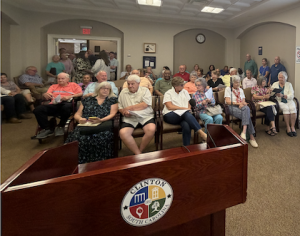
A standing-room-only crowd filled the Clinton City Council chambers Monday night, and after 16 residents spoke against the proposed Cambridge Farms subdivision, council tabled the annexation ordinance rather than take a first-reading vote.
The ordinance would annex roughly 283 acres at Highway 56 and Cambridge Road, now in unincorporated Laurens County, and assign city zoning of R-1, RS-2, RS-3, C-3 and A-R. The property is under contract to Veranda Homes, a Lexington-based builder. The Clinton Planning Commission recommended approval on a 3 to 2 vote in July.
Speakers raised concerns about traffic on Highway 56, flooding along Shell Creek and the Bush River, fire and police capacity, school enrollment, utility rates and the number of residential lots already approved in the city. One resident reported counting 444 cars and 37 tractor-trailers in a single hour Monday afternoon. Another, who won a lawsuit over stormwater damage from a neighboring subdivision, said the same engineering firm is working on Cambridge Farms. A petition opposing the project, signed by nearly 500 city utility customers, was submitted to the clerk. No speaker addressed council in support.
Veranda President Patrick McNair presented the plan with company co-founder Karl Haslinger. The city proposal calls for 490 lots, down from 607 in Veranda’s first city plan and 523 in the plan approved through the county, and adds an 10-acre central park, a pool, walking trails and a small commercial parcel. McNair said a proposed development agreement would cap the lot count, set a minimum lot size and guarantee the amenities.
The developer’s attorney said a circuit court judge ruled in Veranda’s favor on three counts after the county planning commission denied the project, and that Laurens County’s appeal could take several years to resolve.
Council members were divided. Several said the greater risk would be denying annexation and watching the project proceed in the county without a development agreement, impact fees or city tax revenue. Others said the city had told the developer the project needed to be all R-1.
The ordinance had come to the floor earlier in the meeting on a motion to approve first reading, made by Councilor Walsh and seconded by Councilman Smith. During discussion, a member moved instead to table the item for a minimum of two weeks, citing the need to review the city’s draft comprehensive plan, have legal counsel review the proposed development agreement, and hear from an independent attorney on what the pending appeal means for the city. Because a motion was already on the floor, the request was taken up as a friendly amendment, and Walsh amended her motion to table.
Discussion then turned to member availability in late August, and the amendment was revised again to table the ordinance until a date when all council members can be present.
No date was set for first reading.