State of Our Community highlights shared priorities and progress across Georgetown County
September 2, 2026
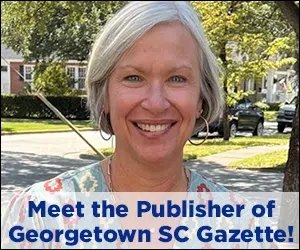
By Karen Owens
Publisher
Members of the business community filled Winyah Auditorium this week to hear local leaders share a forward-looking conversation about the challenges, opportunities, and shared priorities shaping Georgetown County’s future during the Georgetown County Chamber of Commerce’s annual State of Our Community event.
The networking event and panel discussion serve as an annual check-in on how leaders from the county’s three municipalities and Georgetown County government are tackling local priorities, working across jurisdictions, and strengthening the quality-of-life residents value and expect. 
Moderated by former TV anchor-turned-economic development professional Hannah Hall, the panel included elected officials and top administrators from the Town of Andrews, City of Georgetown, Town of Pawleys Island and Georgetown County. Together, they fielded questions from Chamber members and the audience on continued population growth, infrastructure, affordable housing, transportation, workforce needs, business recruitment, and resilience as stronger storms and hurricanes continue to affect the coastal region.
Georgetown Mayor Jay Doyle, a newcomer to the event, pointed to the redevelopment of the Liberty Steel Mill site as one of the city’s most exciting opportunities, with potential to bring new businesses, jobs, housing, and transportation options. Doyle also shared his vision for stronger connectivity across the city, including water taxis and trolleys to help move people between neighborhoods, and said new community development staff would further support the city’s momentum.
His top administrator Scott Whittier expressed gratitude for the recent completion of the new City Hall complex after 10 years of staff being displaced with temporary offices throughout the city. Located in the former Liberty Steel headquarters building in the West End, community members will be able to tour the new facility as part of the city’s grand opening celebration, planned for September 22.

As a rural community, Andrews continues to navigate funding challenges as resources from federal agencies have diminished in recent years, Wilson said. Mayor McClary’s new role as an Executive Committee Board member of the Municipal Association of South Carolina, however, gives him a seat at the table as the organization establishes legislative priorities and policy goals for South Carolina municipalities. That role helps ensure the needs, challenges, and perspectives of small, rural towns like Andrews are part of statewide decision-making.
In Pawleys Island, Mayor Brian Henry and Daniel Newquist said their biggest concerns included increased flooding events, public safety for swimmers, and preserving the island’s laid-back cottage style as growth continues to impact the nearby Waccamaw Neck. The community has undertaken a significant effort to pass a historic preservation ordinance that would provide financial incentives for homeowners to renovate their properties to retain a property’s historic character while mitigating potential storm impacts to avoid losing the seaside charm Pawleys is known for.
Funding is also a concern for Pawleys Island, which relies primarily on Accommodations Tax funds and grants to support major projects. Henry noted that the days when projects such as beach renourishment or drainage infrastructure cost hundreds of thousands of dollars have passed; today, those same needs often reach into the millions, and in some cases even higher.
Georgetown County Administrator Angela Christian and Council Chairman Clint Elliott closed out the individual updates with a focus on economic development and infrastructure. The county is looking to add a new industrial park as the Andrews industrial park nears capacity, and both leaders expressed excitement about progress through the Capital Project Sales Tax, with revenues exceeding projections and several transportation and infrastructure projects moving through planning and implementation.
Christian said the challenge is keeping up with how fast the growth is coming to the region but credited her dedicated team of employees for their great work to make things happen. She pointed to the construction of the new detention center being 80 percent complete, the renovated courts at Stables Park, and several road projects, among others. The master plan for the Port property is underway, and there will be a public input session later in October, for residents to come out and share their feedback on proposed concepts and ideas.
Another important funding source for the county and municipalities is the proposed Local Option Sales Tax ordinance, which will be on the November ballot. Elliott said 71 percent of the revenue collected would provide property tax credits for property owners throughout the county, while the remaining 29 percent would be unrestricted funds for Andrews, Pawleys Island, Georgetown and Georgetown County. Those funds could support needs such as stormwater improvements, animal control officers or walking trails, depending on what each council decides to fund, since there is no pre-approved project list. While the county cannot advocate for the referendum, Elliott said its role is to educate voters in hopes they will support it at the polls in November. (The county is holding a day-long information session on Sept. 10 for residents who want to learn more.)
After a short break, the entire panel reconvened on the stage to express final thoughts and concerns. All echoed the importance of collaboration and ongoing communication with each other to ensure citizens’ needs were met. “Collaboration is so important. We can’t do anything on our own. We have to work together,” Mayor Frank McClary said.
Other challenges addressed included the lack of workforce housing, affordable childcare options for working families, and public transportation options for citizens to get around the county. Fortunately, the region has valuable partners like Tidelands Health and Horry-Georgetown Technical College who are addressing healthcare and educational needs for the area. Leaders expressed a desire to see more people volunteer within the community. 
“This is a special place and as we have new people moving into our communities, we hope they will get to know their neighbors and explore opportunities to volunteer and support organizations that will give them a sense of purpose,” Angela Christian added as panel members shared praise for the work the YMCA and Black River United Way are providing to engage children, youth and young families.
While this was only my second time attending the event, I came away feeling that significant progress has been made since last year’s forum. There seemed to be more camaraderie among the elected officials, and Mayor Henry’s attendance this year added another important voice to the conversation.
Thank you to the Georgetown Chamber for organizing this important community forum, and to everyone who took time out of their busy schedules to listen, ask questions, and engage with our elected leaders. It was encouraging to see civility, respect, and thoughtful conversation on display, offering a welcome reminder of how productive local dialogue can be.