








New scholarships help open a path for future engineers to transfer from Tri-County Technical College to Clemson University
April 14, 2026
Aspiring engineers at Tri-County Technical College will have a new pathway into Clemson University through STEPS2Clemson, a program that provides significant scholarships and academic support for students with demonstrated financial need.
The program offers up to $10,000 in scholarship support during students’ first year, which is completed at Tri-County. After transferring to Clemson, students are eligible for up to $15,000 per year for up to three years, contingent on maintaining academic progress. (Apply here.)
Students accepted into the program will receive a laptop that meets Clemson’s engineering software requirements. STEPS2Clemson also includes mentoring, advising, academic support and professional development.
STEPS2Clemson is designed to expand South Carolina’s pipeline of engineering talent and increase access to engineering education for students across the state and beyond. It also strengthens the long-standing partnership between Tri-County and Clemson, adding another layer of support for transfer students.
Funding for STEPS2Clemson, totaling $5 million, comes from a National Science Foundation program called Scholarships in Science, Technology, Engineering and Mathematics (S-STEM).
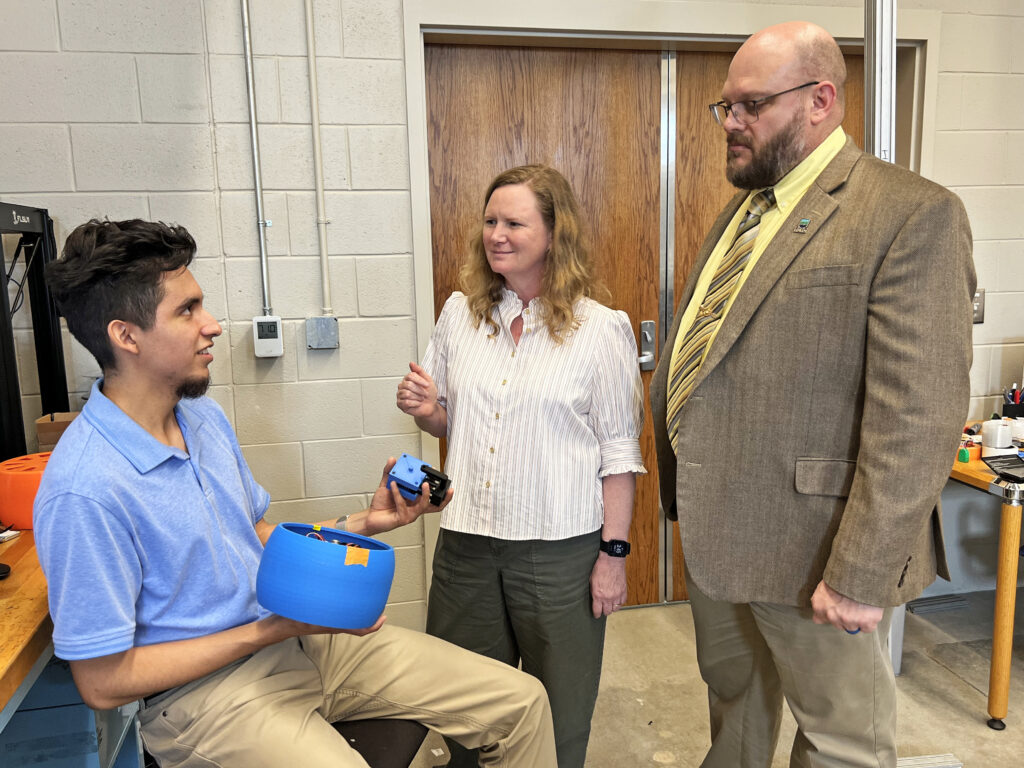
Mary Beth Kurz, principal investigator of STEPS2Clemson and associate professor of industrial engineering at Clemson University, said the program could help students graduate with little to no debt while putting them on the path to an engineering job or graduate school.
“The engineering workforce pipeline needs everyone it can get, and a lack of funds should not hold back the best students in the state from pursuing any of the engineering majors,” said Kurz.
Paul Phelps, dean of the Engineering and Industrial Technology Division at Tri-County Technical College, said, “The STEPS2Clemson program can make all the difference for Tri-County students who have financial barriers that prohibit them from earning a four-year degree. By reducing the financial barriers for our engineering students’ path to Clemson, we hope to attract students who hadn’t considered this as an educational option before. This program, along with other scholarship opportunities, could lead to a substantially reduced financial burden or cost.
“STEPS2Clemson is a purposefully designed program. We worked side by side with our Clemson partners with the goal of positively impacting and supporting students in achieving their educational goals and promoting the pathway to engineering majors. Partnerships like this make attending Clemson University achievable for those beginning their pathway at Tri-County.”
To be eligible, students must be U.S. citizens or permanent residents who are ready to begin calculus coursework and plan to pursue an engineering degree at Clemson. The program is capped at 48 students over three years.
Participants are selected based on academic potential and demonstrated financial need. They are expected to engage in program activities both before and after transfer, including mentoring, academic support and professional development sessions.
STEPS2Clemson builds on SPECTRA, a similar NSF-supported program. Students like Bryan Olvera, a senior majoring in mechanical engineering, participated in Creative Inquiry both within the program and with faculty in their majors and beyond, gaining crucial soft-skills and experience that propel them into their next steps.
STEPS2Clemson is a separate program from Bridge to Clemson, another pathway from Tri-County to Clemson. STEPS2Clemson is open to students in the Bridge program as well as those who start as traditional Tri-County students.
Faculty and program leaders from the two institutions emphasize the importance of sustained support throughout the transfer process:
“Supporting students through the transfer process is just as important as what happens in the classroom. This program allows us to stay engaged with students over time, help them navigate key academic decisions and build confidence as they move into demanding engineering programs.”
David Neyens, co-principal investigator and associate professor of industrial engineering at Clemson University
“Many of our students have the talent and determination to thrive in engineering but encounter challenges when it comes to continuing their education. STEPS2Clemson helps clear that path while providing the support, structure and confidence students need to successfully transfer into a four-year engineering program.”
Foster Sims, department head of Engineering Technology at Tri-County Technical College
“Transitions can be one of the most challenging parts of a student’s academic journey. By intentionally supporting students before and after they transfer, this program helps reduce uncertainty, strengthen belonging and set students up for long-term success in rigorous engineering programs.”
Kris Frady, co-principal investigator and associate professor in the College of Education at Clemson University
Crucial collaborators on STEPS2Clemson also include Kathy Snipes and O. Thompson Mefford of Clemson University.
The first cohort is on track to begin in fall 2026 as first-year students at TCTC. Learn more about STEPS2Clemson and apply at https://cecas.clemson.edu/steps2/.