Urgent Warning: Fake Court Notices Target South Carolina Residents via Text
April 22, 2026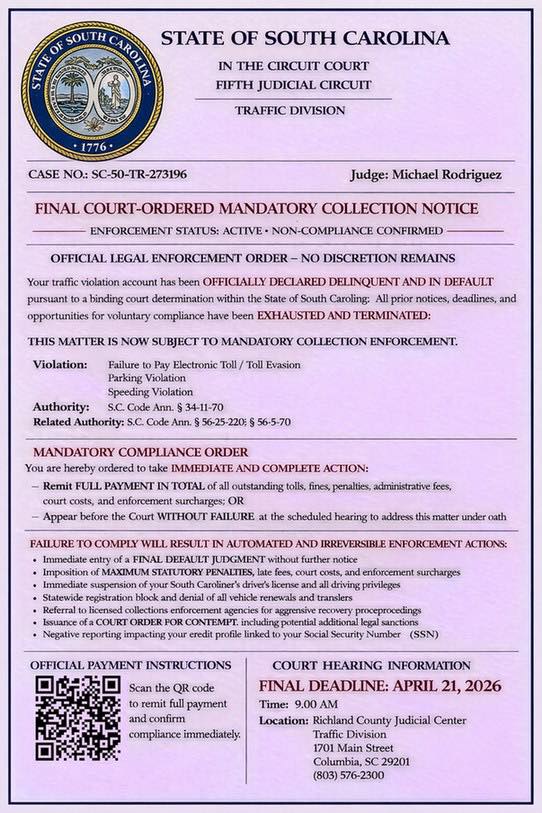
Law enforcement and judicial officials are issuing an urgent warning to South Carolinians following a surge in sophisticated text message scams designed to look like official court orders.
The scam, which has been reported across the state and specifically within the Fifth Judicial Circuit (Richland and Kershaw Counties), uses high-pressure tactics and official-looking legal documents to trick residents into paying non-existent fines.
Anatomy of the Scam
Recipients report receiving a text message containing an image of a “Final Court-Ordered Mandatory Collection Notice.” The document often features the State of South Carolina seal and lists specific—yet entirely fabricated—case numbers and judges.
Scammers are using several psychological triggers to force a quick response:
-
False Urgency: Notices often include an immediate “Final Deadline” (such as April 21, 2026).
-
Intimidating Language: Phrases like “Enforcement Status: Active,” “No Discretion Remains,” and threats of “Immediate Suspension of Driver’s License” are used to create panic.
-
The QR Code Trap: The document directs victims to scan a QR code to “remit full payment.” Experts warn that scanning these codes can lead to phishing sites designed to steal Social Security numbers, banking info, or install malware on mobile devices.
Official Response
The Richland County Government and the South Carolina Department of Motor Vehicles (SCDMV) have both confirmed that these messages are completely fraudulent.
“The SCDMV does not use text messages to collect unpaid traffic tickets or toll violations,” the agency stated in a recent consumer alert. Officials emphasized that legitimate legal notices regarding court hearings or delinquent payments are delivered via the U.S. Postal Service, not through a text message from an out-of-state area code.
How to Protect Yourself
Authorities are urging residents to stay vigilant and look for these red flags:
-
Check the Source: Official court communications will not come from a personal cell phone or an out-of-state area code (like California, as reported in recent cases).
-
Verify, Don’t Click: Never scan a QR code or click a link in a suspicious text. If you are concerned about an actual citation, contact the Richland County Judicial Center or your local Clerk of Court directly using a verified number from a
.govwebsite. -
Report the Fraud: You can report scam texts to your mobile carrier by forwarding the message to 7726 (SPAM) or by filing a report with the Federal Trade Commission (FTC).
If you have already interacted with one of these messages or provided financial information, experts recommend monitoring your bank accounts immediately and contacting the Richland County Sheriff’s Department.
Official Verification Links:
-
Richland County Govt: richlandcountysc.gov
-
SCDMV Official Site: dmv.sc.gov