A Conversation with Loren Wallace, Emergency Manager for Georgetown County
July 13, 2026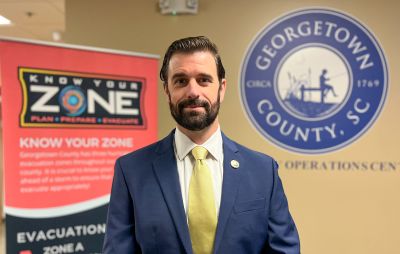
By Karen Owens, Publisher
Behind the scenes of every safe community is a dedicated team working to connect the dots before, during, and after a crisis. In Georgetown County, that effort is spearheaded by Emergency Manager Loren Wallace. Describing his department as the “Switzerland of the emergency services world,” Wallace and his team don’t command the front lines; instead, they coordinate the massive web of government agencies, nonprofits, and public safety partners that keep the county moving when disaster strikes.
We sat down with Wallace to discuss Georgetown County’s unique risk profile, the common misconceptions about emergency management, and the personal, practical ways citizens can prepare for hurricane season.
Georgetown Gazette:
Can you give us a brief description of what your role entails.
Loren Wallace:
Essentially, my role is being responsible for the planning, preparing, responding, recovering from, and mitigating against all disasters.
Georgetown Gazette:
What would you say are the most common hazards or disasters that we face here in Georgetown County?
Loren Wallace:
We have a few common natural hazards. Right now, for instance, extreme heat and drought are common hazards.
When it comes to severe weather, afternoon thunderstorm pop-ups can certainly bring localized consequences. But looking at larger-scale events, being on the coast means hurricanes are our highest-consequence hazard. Rip currents are another frequent natural hazard affecting us.
The good news is we don’t have the geography for avalanches, landslides, or mudslides. However, contrary to what some might think, we do have to consider earthquakes. There are inferred fault lines all throughout South Carolina. If we were to see another major earthquake in Charleston like the one back in the 1800s, we would 100% see an impact here. It’s absolutely something we have to keep on our radar.
Georgetown Gazette:
What is the biggest misconception the average citizen has about emergency services and your specific role?
Loren Wallace:
That’s a good question. In emergency management, we are often entirely behind the scenes. I like to describe us as the Switzerland of the emergency services world. We aren’t necessarily the boots-on-the-ground responders. Instead, we are typically in the Emergency Operations Center (EOC) or an incident command post supporting and coordinating ongoing operations. We command nothing—we coordinate everything.
While “emergency services” encompasses active front-line agencies like Fire and Rescue, emergency management spans the whole of government and the whole community. When we stand up the EOC during a natural disaster, we are coordinating public safety, public works, damage assessment teams, code enforcement, and our nonprofit partners via VOAD (Voluntary Organizations Active in Disaster). Our job is to ensure everyone is rolling in the same direction and that there is no duplication of effort.
Georgetown SC Gazette:
I’ve heard you talk about the importance of the “4 Cs” of Emergency Management. Can you tell our readers about what they are and why they matter?
Loren Wallace:
Emergency management relies on a framework borrowed from the VOAD world: Communication, Coordination, Collaboration, and Cooperation. No single agency, department, or sector can handle a disaster alone. It takes a fostered spirit of day-to-day relationship building to ensure we can effectively work together when it counts.
Georgetown Gazette:
We are currently in the middle of hurricane season. What are the most common challenges a citizen might experience during a storm, and what should they think about to prepare?
Loren Wallace:
In emergency management, “commonality” is relative because everyone’s risk profile looks different based strictly on where they live. If you live in Pawleys Island, your risk profile looks completely different than if you live inland in Pleasant Hill.
The first thing we tell everybody is to know your zone. You need to look up your address on Hurricane.sc to see if you are in Evacuation Zone A, B, or C, which determines your storm surge risk.
Beyond that, tropical systems bring universal threats: wind, coastal or riverine flooding, flash flooding, and tornadoes. But what is truly common to us all is the potential for long-term power outages and communication disruptions. We rely heavily on cell phones, but they may not work.
We want everyone to look around their property before the storm hits. Are there limbs hanging over your house? Getting those removed now is a simple way to mitigate damage later.
Georgetown Gazette:
What are the most important things that everyone needs to have in their emergency preparedness kits?
Loren Wallace:
I always tell people to build a kit that makes practical sense for their specific household. The baseline basics apply to everyone: food and water for at least three days (72 hours), calculating a couple of gallons of water per person per day.
Beyond the basics, think about these essentials:
- Alternate Lighting: Use flashlights with extra batteries instead of candles. We want to avoid candles because they introduce a fire hazard, and we don’t want cascading incidents compounding the storm.
- Food Choices: If you pack canned food, make sure you have a manual can opener. And be realistic—if you don’t like lima beans before a disaster, don’t put them in your kit. Pop-tarts work just as well, require no cooking, and won’t make a miserable situation more miserable.
- Family & Pets: If you have infants, ensure you have formula and diapers. If you have kids, pack coloring books. Don’t forget food and water for your pets, too.
- PPE & Safety Gear: Following an event, you’ll likely be clearing debris. Have gloves, safety goggles, and a solid first aid kit on hand. If you are using a chainsaw or a generator, know how to operate them safely and keep generators outdoors in well-ventilated areas.
Georgetown Gazette:
You also mention “vital documents.” Why are these so critical?
Loren Wallace:
Your vital documents are the starting point to reconstituting your life after a disaster. Whether you are staying put or evacuating, you need to gather your vital information into a secure, grab-and-go container. This includes bank account details, insurance policies, and copies of birth certificates.
Because we rely so heavily on our phones, write down your key contact information on paper. The same goes for health information. Keep a written list of your daily medications. If you have to seek medical attention or see an alternate provider post-event, having that physical list to share is vital.
Georgetown Gazette:
How did you personally get involved in emergency management? What drew you to this line of work?
Loren Wallace:
I’ll go way back. I’m originally from the Upstate—Spartanburg, South Carolina—and I started out volunteering with a fire department there. One day, we showed up to a scene, and there was a guy already there in a vehicle equipped with red and blue lights, fully geared up and heading into the house. I asked who he was, and they told me he was the county emergency manager. I remember thinking, “That seems like a really cool job.”
That was my introduction, but my path here actually wound through the Salvation Army. I moved to Georgetown in 2013 as a Salvation Army officer and became heavily involved in emergency disaster services and the local VOAD.
Between the Georgetown Treasury fire in 2013, severe winter weather in 2014, and the historic floods of 2015, we faced a lot of challenges. Following the 2015 floods, Lucy Woodhouse (the United Way director at the time) and I set up the Long-Term Recovery Group for Georgetown and Williamsburg counties to help people get back on their feet.
Eventually, I came to work for the county in Parks and Recreation. In Georgetown, we all wear multiple hats. I also served as the deputy logistics section chief in the EOC for subsequent storms, spent some time working in Horry County under our former emergency manager Sam Hodge, and ultimately stepped into this role.
At the end of the day, emergency management is an interdisciplinary, public-service function. It’s about connecting all the pieces of our community, and it is simply one of the best ways to help people.
There is wealth of emergency preparedness information and resources on Georgetown County’s website. Stay tuned for additional articles about how businesses can prepare for emergencies as well.