








CAMBRIDGE FARMS — BEFORE THE VOTE 490 Homes. Two Votes. First One Monday.
July 29, 2026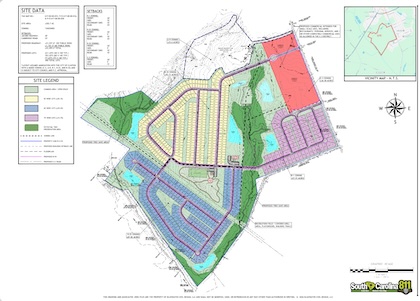
Clinton City Council takes up the Cambridge Farms annexation on August 3. It takes two readings to pass it. Here is what the public record shows — and why the room needs to be full for both.
By Brenda Stewart
Monday night, Clinton City Council takes up first reading of an ordinance to annex 283 acres on Highway 56 South and zone it for a 490-lot subdivision. Passing it takes two readings, and the second is expected about two weeks later at a special called meeting. So there are two chances to be heard — and the first one shapes the second.
Nothing about this is urgent. Roughly 2,200 homes are already approved inside Clinton city limits, and newer subdivisions are still working through lots that haven’t sold. The only thing moving fast here is the approval. A decision made in the next few days will set the traffic on Highway 56, the load on city water and sewer, the drainage of nearly 300 acres and the character of the south side of Clinton for the next thirty or forty years. Everyone at the table Monday will eventually move on. The residents will still be living in it.
Six facts from the public record, before anyone votes.
- The County is fighting this in court right now.
The Laurens County Planning Commission denied Cambridge Farms 5–0. A circuit court reversed that denial in May. The County appealed to the S.C. Court of Appeals on June 9, and that appeal is still pending. Weeks after it was filed, the developer came back to Clinton.
At the July 14 hearing he waved the appeal off — calling it a one-page filing with no stated reasons, questioning whether the County met its deadline, and telling the Commission that fewer than ten percent of appeals nationally succeed.
An attorney who argues these cases for a living told the Commission something very different. Michael Corley, deputy director of the South Carolina Environmental Law Project, said his organization appears regularly before that court and has had considerable success there overturning lower decisions in land planning and environmental cases. He also put the County vote in context: subdivisions ordinarily get approved, split votes are uncommon, and a unanimous denial is close to unheard of.
One of those men argues appeals for a living. The other profits if this one goes away. Clinton is being asked to bet on the second one.
- The zoning isn’t what the picture shows.
The project was presented as meeting Clinton’s R-1 standard. R-1 requires 7,500 square feet of lot area and 70 feet of lot width — by the applicant’s own description, a 70-by-107 lot. Asked why he wasn’t simply requesting R-1, the applicant answered plainly: the reason for the RS-2 and RS-3 request is the width limitation in R-1. The entry-level section is platted at 50 feet wide, not 70. He explained the benefit himself — 50 feet of road, storm drainage, utilities and sidewalk per house instead of 70.
So, this was never really about lot size. It’s about frontage — squeezing 29 percent more houses onto every foot of pipe and pavement and still calling it R-1. If it truly met R-1, nobody would need to ask for RS-2 and RS-3.
- The track record belongs to other companies.
Asked whether the company could finance this, the applicant said he and his partners had been in business since 1993 — while conceding it “might be a new name or new brand,” and explaining away the red ink raised at the County hearing as first-year startup losses. Both cannot carry the same weight. Veranda Homes’ own federal trademark filing states first use in commerce on April 29, 2024. The Lexington-area subdivision he walked the Commission through on screen was developed under a different company name.
A company explaining its first-year losses is not a company with a 33-year balance sheet. Pick one.
- Much of this was worked out in rooms the public wasn’t in.
City records obtained under FOIA document a private meeting on April 23. A May 25 email from the developer asked that the mayor and one other council member attend follow-ups — two at a time, below the number that triggers open-meetings law. On June 16, the project engineer emailed the City planner asking which zoning would be “in our best interest.”
The developer has had the City’s ear since April and perhaps earlier. The public gets two minutes at a microphone on Monday.
- A commissioner’s question went unanswered until after the vote.
Asked at the July 14 hearing about a northern-county development that damaged a neighbor’s property, the applicant said no — without mentioning that Bluewater Civil Design, the engineer on that project, is the engineer on Cambridge Farms. I passed a note to city planner, Phil Linder, asking for clarification before the vote. It didn’t happen. Instead, it came after adjournment, after the Commission had voted 3–2.
The answer arrived too late to matter, intentionally. That is not a technicality. That is how a 3–2 vote happens.
- The environmental homework isn’t finished.
The applicant says an outside licensed engineer confirmed no structures will sit in a floodplain or wetland. That is not the same as the work being finished. The County’s own technical review still requires an Army Corps of Engineers permit for the wetland crossing inside the project, and the analysis that would establish base flood elevations was made a condition of approval rather than a completed study. Residents who live downstream asked the Commission to wait for a Corps study first. One traced the path: water off the college and Maple Street runs into Shell Creek, and Shell Creek feeds the Bush River at Joanna. A landowner from the north end of the county described 300 acres cleared next to her property, months of silt-laden runoff, and citations for sediment reaching the waters of the state.
Nearly 300 acres of roofs and pavement have to send that water somewhere. Downstream is not a hypothetical, it’s somebody’s yard.
And then there’s the arithmetic.
A retired commercial real estate lender with roughly 30 years in the business told the Commission he doubted a loan on this project would have cleared underwriting in his career. He noted the R-1 houses are anticipated in the mid-$400,000s, that no comparable sales in or near Clinton support that price, and that the same builder is selling in Gray Court in the $350,000s. A development that stalls halfway through doesn’t disappear. It sits there, half-built, and the City inherits it.
Clinton doesn’t have a shortage of approved lots. It has a shortage of buyers — and 490 more won’t fix that.
Nobody here is against growth. This is the wrong project, on an unfinished record, at the wrong moment. Council should defer until the Court of Appeals rules and these questions are answered in public. If it won’t defer, it should vote no on Monday, and again at second reading.
| BE THERE
First reading — Monday, August 3, 6:00 p.m. P.S. Bailey Council Chambers, M.S. Bailey Municipal Center, 211 N. Broad Street, Clinton Second reading is expected about two weeks later at a special called meeting — watch for the date. Want to speak? Get there before the meeting starts and sign up at the door. You get two minutes — come with your name, your address, and one point. Don’t want to speak? Come anyway. Elected officials count the chairs. A full room is its own argument. Sign the petition. If you have a Clinton address, add your name today — every adult in the household signs separately. Click HERE to sign the petition. Can’t make it Monday? Email your council member today and ask them to defer the vote: Mayor Randy Randall, Danny Cook (1), Anita Williams (2), Natalie Cogsdill (3), Gary Kuykendall (4), Danny Smith (5), Megan Walsh (6). Contacts at cityofclintonsc.com. |
Live outside the city limits? You’ll get the traffic on Highway 56 and the runoff toward the Bush River either way — the seat you fill Monday counts just as much. And you almost certainly know people with a Clinton address who haven’t heard about this. Send them the petition.