








Clemson University dedicates state-of-the-art Forestry and Environmental Conservation building
September 15, 2026
This unique, sustainably constructed facility was made possible thanks to support from individuals, industries and the state.

Clemson University announced the dedication of its newest innovative campus facility, the Forestry and Environmental Conservation (FEC) building. Positioned at Clemson’s southern entrance at the intersection of Cherry Road and Perimeter Road, the four-story, 85,000-square-foot mass timber facility blends cutting-edge science with elegant, sustainable design. First envisioned back in 2018, the culmination of this building project marks a historic milestone for sustainable architecture in the Southeast.
Celebrating a new era of stewardship for forestry and natural resources
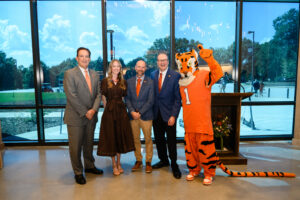
Many of the individuals, University leaders and industry partners whose support helped make the project possible gathered on September 11, 2026, to celebrate the dedication of the Forestry and Environmental Conservation building with a ribbon-cutting. The building is home to the University’s Department of Forestry and Environmental Conservation (FEC), part of the College of Agriculture, Forestry and Life Sciences (CAFLS). “The new Department of Forestry and Environmental Conservation facility is a significant investment in our students, faculty and staff. This innovative, sustainably designed facility reflects Clemson’s commitment to delivering the No. 1 student experience, advancing research and preparing the next generation of leaders to steward South Carolina’s natural resources. Through facilities like this, we continue our commitment to excellence and meeting our land-grant mission of positively impacting lives and communities across South Carolina and beyond,” said University President Benjamin C. Ayers.
This landmark facility represents the innovative and collaborative nature of the Department of Forestry and Environmental Conservation. Designed specifically to support classroom learning, research development and field work, its key location at the transition point where campus blends with community is no coincidence. Students, faculty and field professionals will utilize its modern laboratories, prep spaces and conference facilities.
Situated on a prominent corner of campus, this beautiful building will welcome back proud alumni and serve as a source of inspiration for generations of Clemson Tigers. The cutting-edge sustainable architecture is a testament to the deep dedication and passion of FEC students, faculty and partners. This new space marks a bold new era for forestry and natural resources conservation in South Carolina and beyond.
Celebrating the generosity of the Clemson Family

In recognition of the generous support of Cornerstone donors Micky and Amy Scott, Clemson University has named the central gathering space of the new facility the Scott Family Lobby. Mitchell S. “Micky” Scott ’75 is a forest management alumnus and president of Collum’s Lumber Products in Allendale, South Carolina. His wife, Amy, is a retired registered nurse and University of South Carolina alumna. Together, they have been staunch advocates and philanthropic supporters of forest and natural resource education at Clemson. They have established seven endowments that provide critical student, faculty and programmatic support.
The Scotts’ legacy includes endowments providing need-based scholarships for students attending Forestry Summer Camp, undergraduate recruitment scholarships and fellowships for graduate students enrolled in the FEC program. Their generous gifts to the College of Agriculture, Forestry, and Life Sciences made them the first-ever Academic Cornerstone Partner for CAFLS. “The Scotts have been tremendous champions for our students and for the future of forestry at Clemson,” said department chair Kyle Barrett. “It is only fitting that this space, where students and faculty will come together to learn every day, carries their name.” The Scotts’ legacy reflects their passion to shape the future of South Carolina’s natural resource workforce and ensure students, faculty and staff have access to the facilities needed to thrive. The Scotts have also provided ongoing support for Clemson’s groundbreaking Wood Utilization + Design Institute.

The development of the landmark facility is a testament to the power of private philanthropy and corporate support, showcasing the vital connection between healthy forest management and sustainable construction. The building utilizes cross-laminated timber (CLT) made from regional Southern Yellow Pine. The wood used in the facility’s 62,000 square feet of CLT components was donated by Norfolk Southern and harvested from their Brosnan Forest in the South Carolina Lowcountry. To honor this generous gift, Clemson has dedicated a state-of-the-art classroom laboratory in the new facility to Norfolk Southern, celebrating the company’s sustainable role in this project. The Norfolk Southern Teaching Lab will be a part of nearly every FEC student’s journey going forward. In addition to the timber sourced from Brosnan Forest, trees removed from the Clemson campus during site preparation were salvaged and repurposed into custom shelving.
Where collaboration and innovation meet conservation, education and exploration
The doors are officially open, and classes have begun in the new FEC building. As forestry and conservation students enjoy the immersive living classroom, the design ensures they will experience the essential connection between the built and natural environments. The successful completion of the FEC building stands as a proud showcase of collaboration within the Clemson Family. Clemson graduates have been integral to the project’s success, serving as project managers, superintendents and subcontractors. The faculty and students in the Department of Forestry and Environmental Conservation are doing cutting-edge science and outreach to aid conservation and management of natural resources in South Carolina and beyond. This new building provides the space and resources needed to help Clemson deliver the No. 1 student experience.
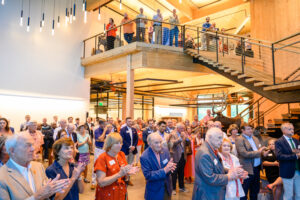
“We wanted a home for FEC that represented the character of the department and the future its graduates are helping to shape, and this building does that through its materials, its flexibility and its strong connection to the campus landscape,” reflected Dean Matthew Holt of the College of Agriculture, Forestry and Life Sciences. “This building connects the past and the future of our ever-important Forestry and Environmental Conservation department and reflects the spirit of the University’s land-grant mission with its threefold mission: teaching, research and extension.”
About the Department of Forestry and Environmental Conservation
Clemson’s Department of Forestry and Environmental Conservation (FEC) prepares leaders in sustainable forestry and wildlife and fisheries conservation and ecology through excellence in instruction, scientific inquiry and outreach to citizens of South Carolina, the nation and the world. FEC partners with industry, state and federal agencies, and non-government organizations to protect and advance our region’s most valuable assets: its forest, wetland and aquatic ecosystems.
FEC is comprised of faculty located on the main campus in Clemson and at the Baruch Institute of Coastal Ecology and Forest Science, a Clemson University research center in Georgetown, South Carolina. The department offers undergraduate majors in environmental and natural resources, wildlife and fisheries biology, and forest resource management. FEC also offers graduate degrees in wildlife and fisheries biology and forest resources, as well as a Master of Wildlife and Fisheries Resources (MWFR).
About the College of Agriculture, Forestry and Life Sciences
The College of Agriculture, Forestry and Life Sciences is at the center of Clemson University’s land-grant heritage and is the driving force behind founder Thomas Green Clemson’s vision of a distinguished center of learning that would reach beyond the boundaries of the academy to benefit South Carolina, its people, land, wildlife, natural resources and economy. CAFLS brings together the land-grant mission of teaching, research and Extension through world-class educational, inquiry and outreach opportunities, and partnerships with private industry and state and federal agencies.