









Lander professor discusses the ‘Spirited’ Story of a new nation ahead of America’s 250th
July 1, 2026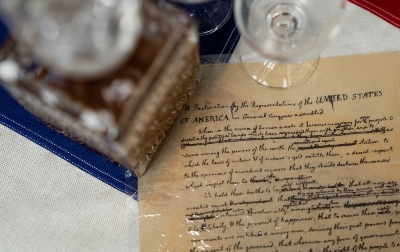
As America commemorates its 250th birthday, many of the nation’s founding stories center on the debates and battles that secured independence. But another part of everyday colonial life flowed alongside those historic events: the widespread use of alcohol.Whether served in taverns or enjoyed in private homes, rum, beer, cider and whiskey were woven into the fabric of colonial society. In fact, the consumption of alcohol was reflected in the customs, economy and culture of a young nation finding its identity.
Dr. Andrew Jameson, an associate professor of English at Lander University, has studied the history and customs of alcohol in America, and has found that the “spirits of America” were more than simple refreshments.
Alcohol, a vital trade commodity, was also used for medicinal remedies and became a symbol of hospitality, Jameson said, calling the colonies’ taverns and inns “the places where the original conspirators met and exchanged ideas that led to revolution.”
These locations “became gathering places where colonial leaders discussed politics, their dissatisfaction with British rule and debated the ideas that ultimately shaped a revolution,” he said. “Samuel Adams, a famous brewer and Revolutionary War patriot, now has a beer named for him.”
Understanding the role of alcohol in colonial America offers a fascinating glimpse into the daily lives of the men and women who lived through the nation’s founding and provides another lens through which people today can appreciate America’s 250-year journey.
The Colonists Drank… A Lot!
Within the larger cities of the growing America, many questioned the safety of water and turned to alcohol as safer choice of beverage consumption. However, beyond the larger cities in frontier areas around today’s states of Kentucky and West Virginia, water was pristine, he said.
“The water quality in Kentucky, for example, had a significant impact later on the growth of the bourbon industry,” he said.
Around the time that George Washington became president in 1789, Americans consumed about 6 gallons of alcohol annually – a number that grew to about seven gallons before going into a decline, Jameson said, noting that alcohol consumption has declined significantly over the years with Americans drinking only about an average of two gallons annually.
It’s not a stretch to imagine that many people might have gotten through the day “with a buzz and may have been low-grade alcoholics,” he said.
The type of alcohol that was consumed also was impacted by the traditions of their countries. The British, Scots and Irish favored beers, ales and hard ciders, Jameson said.
“People also made use of what was available to produce beverages,” he added. “Peach brandy was highly prized and was quite strong and powerful. Molasses from the British Caribbean islands was brought to America to make rum, which was critical to colonial life.”
Alcohol and the Making of a President
When George Washington made his first foray into politics in a 1755 campaign for the Virginia House of Burgesses, he dismissed political consultants who advised him to supply voters with alcohol. He lost in a landslide, Jameson said.
But Washington learned a lesson. For his 1758 campaign for the House of Burgesses, he purchased beer, cider, wine, rum and rum punch for the electorate. His victory paved the way for his political future.
Washington himself was known to drink a bottle of Madeira nightly. As the commander of America’s troops, Washington realized that alcohol was important to readying soldiers for battle and maintaining morale. When the Continental Army moved to Valley Forge in December 1777, “Washington went to great lengths to find supplies of alcohol for his troops,” said Jameson. “Morale was low, and the daily rations of alcohol were in short supply.”
Beyond the battlefield, Washington loved a good party. At a raucous celebration on Sept. 14, 1787, in Philadelphia – just days before the signing of the U.S. Constitution – Washington was among 55 guests who consumed 50 bottles of claret, 54 bottles of Madeira, 22 bottles of port, 12 bottles of beer, eight bottles of hard cider, eight bottles of whiskey and seven large bowls of alcoholic punch.
“In today’s money, the bill was more than $15,000, which even by modern standards is quite a tab,” Jameson said.
After the war, Washington developed a distillery at his Mount Vernon estate. By 1799, the last year of his life, the business produced 11,000 gallons of whiskey, sold to neighbors and in stores in Alexandria and Richmond, Virginia.
Cheers to the Founding Fathers
Among the other Founding Fathers of the nation, alcohol consumption was a daily practice, but tastes varied.
Thomas Jefferson, considered the author of the Declaration of Independence, had a world-class wine cellar, Jameson said. Guests to his estate, known as Monticello, consumed some of the finest wines in the world.
However, Jefferson considered himself a responsible drinker and was quoted as saying, “My measure is a perfectly sober one of three or four glasses at dinner and not a drop at any other time.”
Statesman and inventor Benjamin Frankin, who assisted in the drafting of the Declaration of Independence and was one of its signers, was known for his signature milk punch, which included six quarts of brandy. Although he disapproved of drinking beer at work, Franklin once said that wine “is constant proof that God loves us and wants us to be happy.”
America’s Spirits Evolved
As the nation grew and people moved westward, America’s tastes evolved, Jameson said.
With the onset of the Gold Rush in California in the 1850s and 1860s, miners consumed whiskey and brandy, and the region’s wine industry started to develop. Later, with the availability of ice and improved types of alcohol, new drinks were developed as “people said ‘what can we mix together,’” according to Jameson.
Reflecting on the nation’s early drinking history, Jameson said, “It’s a good thing we don’t drink as much as we used to. But we’ve also lost of sense of camaraderie that we had during the time of cocktail parties that people enjoyed in the 1950s and 1960s. People were a lot more social.”
While Americans’ relationship with alcohol has changed dramatically over the centuries, the drinking customs established during the nation’s founding left a lasting imprint on the country’s social traditions and identity — making the “spirits of America” an enduring part of our nation’s story.