Recognizing the Signs: How South Carolina Is Working to Improve Stroke Survival
May 20, 2026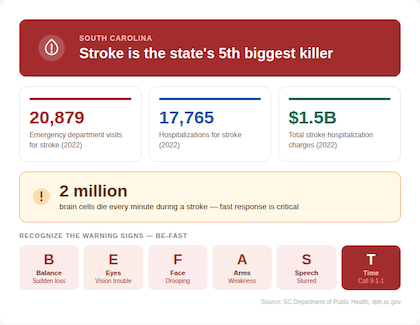
Stroke by the Numbers in South Carolina
The toll stroke takes on South Carolinians is significant. According to the SC Department of Public Health, stroke is the state’s fifth biggest killer. In 2022 alone, there were more than 20,800 emergency department visits for stroke in the state, more than 17,700 hospitalizations, and $1.5 billion in total hospitalization charges.
What Is a Stroke?
A stroke occurs when a blood vessel in the brain is blocked or ruptures, cutting off blood supply and causing brain cells to begin dying within minutes. The condition can result in lasting brain damage, permanent disability, or death. Every minute matters — a stroke kills nearly 2 million brain cells per minute, making the speed and quality of the initial response critical to a patient’s outcome.
Warning signs include sudden numbness or weakness of the face, arm, or leg — especially on one side of the body — sudden confusion, trouble speaking or understanding, sudden trouble seeing, sudden trouble walking or loss of balance, and sudden severe headache with no known cause. DPH uses the BE-FAST acronym — Balance, Eyes, Face, Arms, Speech, Time — to help the public recognize and respond to stroke symptoms quickly. If a stroke is suspected, call 9-1-1 immediately.
Investing in Better Care
In recognition of Stroke Smart South Carolina Month and National Stroke Awareness Month in May, DPH funded certification in Advanced Stroke Life Support (ASLS) for four healthcare providers in each of the state’s four regions — 16 providers in all. The ASLS program was developed through a partnership between the American Heart Association and the University of Miami’s Gordon Center for Simulation and Innovation in Medical Education. It trains both prehospital and in-hospital providers to quickly identify stroke symptoms, make rapid assessments, and deliver early interventions aimed at reducing death and long-term disability.
The ASLS curriculum is used by hundreds of hospitals, fire rescue, ambulance and EMS systems, and educational institutions across the country and around the world. Providers who complete the course receive a two-year certification through the American Heart Association along with eight hours of continuing education credit.
For more information on stroke awareness and DPH’s efforts, visit dph.sc.gov.