









The remarkable life of William Rose topic of next Noon Debrief
July 8, 2026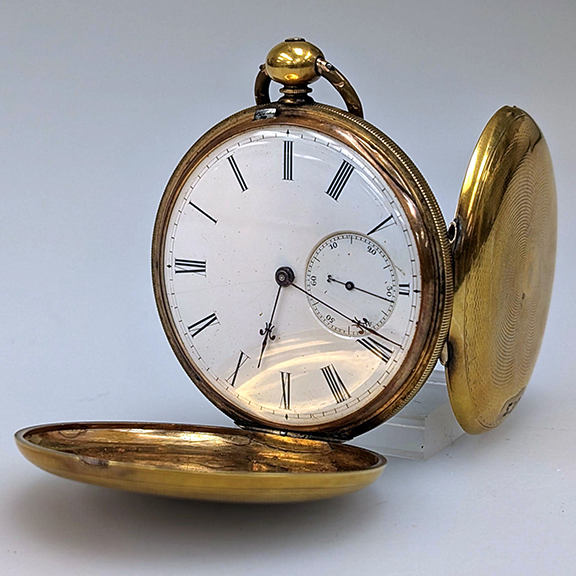
Maxcy Gregg stood out among South Carolinians as one of the fiercest defenders of slavery and advocates of secession.
He wrote an influential manifesto advocating his views, signed the South Carolina Ordinance of Secession, served the Confederacy as a brigadier general in the Civil War, and was mortally wounded at the Battle of Fredericksburg in 1862.
As he lay dying, he gave his watch – so often a man’s most precious heirloom – to William Nesbit Rose. Rose was not his son (Gregg had no children) or any other relative, or a fellow Confederate officer. Rose was a slave. Not Gregg’s slave, but Gregg had leased him from his owner to serve him during the war. Rose brought Gregg’s body back to South Carolina. The watch is now on display at the South Carolina Confederate Relic Room and Military Museum.
At noon on Friday, July 24, the museum’s Curator of Education Joe Long will deliver a free lecture on “Maxcy Gregg and William Rose.” The talk, at the Cayce-West Columbia Branch of Lexington County Public Library at 1500 Augusta Road in West Columbia, is open to the public as part of the museum’s regular Noon Debrief program.
Long has spoken on previous occasions about Gregg. This time, he will have a lot to say about Rose. Long recently spoke – on Confederate Memorial Day – at the dedication of Rose’s headstone at Randolph Cemetery in Columbia.
William Rose’s story is a rich and fascinating one.
He was born into slavery in Charleston, and had seen combat twice before the Civil War. He accompanied Pierce Butler (who would later be a governor of South Carolina) to the Second Seminole War in 1836. He was Butler’s servant, but he also served as a company drummer. For his drumming, he became the only black veteran to receive a U.S. military pension for his service in that war.
In 1847, Butler took Rose to the Mexican-American War. In a foreshadowing of Fredericksburg, Butler was killed at the Battle of Churubusco. William Rose found his body and accompanied it home to South Carolina, as he would later do for Gregg.
He would continue his association with the South Carolina militia after the war, rising to sergeant and eventually to captain. He would serve 11 governors as a messenger, starting with Wade Hampton. He became quite a legend. Visitors to the State House would seek him out to hear his stories of his eventful life. He became known nationally, and was profiled in The New York Times.
About the South Carolina Confederate Relic Room and Military Museum
Founded in 1896, the South Carolina Confederate Relic Room and Military Museum is an accredited museum focusing on South Carolina’s distinguished martial tradition through the Revolutionary War, Mexican War, Civil War, Spanish-American War, World Wars I and II, Vietnam, the War on Terror, and other American conflicts. It serves as the state’s military history museum by collecting, preserving, and exhibiting South Carolina’s military heritage from the colonial era to the present, and by providing superior educational experiences and programming. It recently opened a major new exhibit, “A War With No Front Lines: South Carolina and the Vietnam War, 1965-1973.” The museum is located at 301 Gervais St. in Columbia, sharing the Columbia Mills building with the State Museum. For more information, go to https://crr.sc.gov/.