Timeless Georgetown: The Lost Vessel Beneath the Black River
July 15, 2026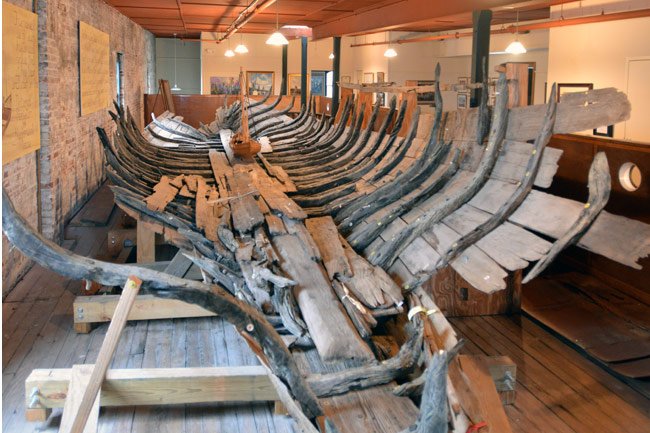
By Mary Boyd
Timeless Georgetown is a series dedicated to the rich history and stories that shaped Georgetown, South Carolina—the third-oldest city in the state. From the strategic maneuvers of the Revolutionary War to the cultural evolution of the “Rice Coast,” we explore the legends and landmarks that define our heritage. Join us as we look beyond the modern landscape to discover the people and events that paved the way for the Georgetown we know today.
In 1971, a dive club took to the murky waters of Black River near the site of a Colonial ferry and landing known as Brown’s Ferry. Divers spent the day leisurely exploring and began to find artifacts, including an intact Rhenish ware mug and 18th-century bottles. Many times that day, they crossed over a mound of bricks at the base of the landing. Little did they know what treasure lay beneath them. The Brown’s Ferry Vessel would become the oldest vessel ever recovered in American waters.
In 1974, Hampton Shuping and his diving friends came across the remnants of a vessel in the Black River at Brown’s Ferry, buried under mud with only a few inches of its hull visible. They began to dig the mud away and soon uncovered a Davis quadrant, a wooden instrument used for navigation. Cognizant of conservation requirements, they reburied it for retrieval at another time. Other artifacts came to light as well, including a slipware cup and a broken delft bowl. These finds were reported to the newly created South Carolina Institute of Archaeology and Anthropology (SCIAA). Months later, Mr. Shuping was joined by Dr. Newell Wright of Coastal Carolina University to take a serious look at the vessel’s structure. It was buried under a cargo of about ten thousand 18th-century bricks. In the final tally, finds included a lead seal bearing the coat of arms of the city of Amsterdam, coins, a sword, and 8,000 to 10,000 bricks.
With the artifacts found earlier, together with the hull of a very interesting vessel, it was decided to initiate recovery efforts in the summer of 1976. With volunteer divers and SCIAA’s underwater division, the project took six weeks and was completed on a shoestring budget. Local businesses helped fund the efforts. The hull of the Brown’s Ferry Vessel emerged from its 200-year resting place at the bottom of Black River on August 28, 1976, to the delight of more than 8,000 observers.
The vessel was trucked to Fort Jackson, where it was kept under a sprinkler system for several months. Renowned ship reconstructionist Dick Steffy joined the project to build a model based on measurements of the vessel and to hypothesize what the rigging and hull had been. Steffy surmised that the vessel was double-ended, with a pointed stern. From 1977 to 1983, the vessel was submerged in a farm pond near Columbia while awaiting construction of a facility in which it would be immersed in a treatment of polyethylene glycol. In 1990, the treatment process was completed. The vessel could now be safely exposed to air and reexamined and studied. It was then thought that the vessel had a square stern.
The vessel returned to Georgetown in July 1992. Contractors removed part of the roof of the Kaminski Building on Front Street, and a crane was used to hoist it into its new home on the third floor. SCIAA staff, under the direction of State Archaeologist Dr. Jonathan Leader, reconstructed the vessel. She was ready for her public debut on July 31, 1992.
In his study published in 1979, Dick Steffy concluded: “In my opinion, it is the most important single nautical discovery in the United States to date. In the first place, it establishes primary evidence for American shipbuilding nearly fifty years earlier than previous discoveries. More importantly, this was a merchant hull, built without anxiety, bureaucracy, and inefficiency often associated with vessels of war. As such, it defines everyday technology in a competitive atmosphere. Additionally, this was a local type—important to any maritime scholar—representing a period and area in which far too little maritime information has been forthcoming.”
About the Author
Mary Boyd is a dedicated local historian with a deep passion for preserving and sharing the rich narrative of Georgetown County. She is closely associated with the Georgetown County Historical Society Museum and is a frequent contributor to local historical research. Mary warmly welcomes queries from the community regarding Georgetown’s unique history and cultural heritage.
Get in Touch: For questions or to learn more about the museum’s collections, you can reach Mary at [email protected].