U.S. Senate hopefuls make their case at Lexington stump stop
August 2, 2026
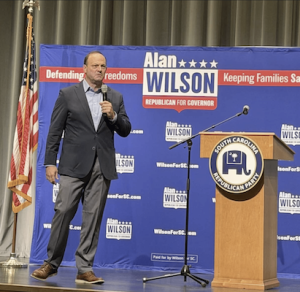
Nine candidates for South Carolina’s open U.S. Senate seat took the stage Saturday at River Bluff High School in Lexington, each given a few minutes to introduce themselves and one question from a panel of students. More than 400 people filled the school auditorium.
Attorney General Alan Wilson, the Republican nominee for governor, hosted the event and delivered the opening remarks. The state Republican Party and the Lexington One school district’s Center for Law and Global Policy also helped put the program together.
How the event came together
The seat became vacant following the death of U.S. Sen. Lindsey Graham, who died July 11 in Washington. Organizers opened the event by acknowledging how quickly the field came together, noting that most candidates had less than a month to weigh a decision that normally takes months of conversation with family and clergy. They also stressed that the questions were written by River Bluff students and had not been shared in advance with the party, the candidates or event staff. Speaking order was set by a drawing the day before.
Common ground ran through most of the speeches. Nearly every candidate called for tighter immigration enforcement and deep cuts in federal spending. The clearest split came over Iran, where two candidates broke with the White House on how the conflict has been handled.
Darline Graham
Graham, sister of the late senator and appointed in mid-July to serve out the remainder of his term, opened by offering condolences to the Lexington County Sheriff’s Office following the death of a master deputy. She told the crowd she never expected to seek public office and is running in response to President Donald Trump’s request, citing his endorsement. She pointed to seven years leading a state agency with about 138 employees and a budget near $90 million, and described herself as an expert on the family budget rather than the federal one. She voiced support for voter identification requirements, stricter immigration enforcement and the Second Amendment. Asked by a student about election security, she said she is co-sponsoring federal legislation requiring proof of citizenship to register to vote, a measure that has cleared the U.S. House but stalled in the Senate. It was the first bill she signed onto after taking office.
Glenda Gail Parker
Parker introduced herself as the only independent candidate to qualify for the ballot and told the audience that a majority of voters identify as independents. A retired Air Force officer and former budget analyst for the Department of Defense, Parker has run for U.S. Senate twice before in Virginia. She centered her remarks on the national debt, which she put at roughly $39 trillion, and argued that interest payments are now among the largest items in the federal budget. Asked which programs she would cut, Parker said she would protect Social Security and Medicare and instead focus on lowering transportation and energy costs to bring down inflation and interest rates, along with examining defense spending.
Russell Fry
U.S. Rep. Russell Fry of Surfside Beach, who represents the 7th Congressional District, described a working-class upbringing and credited his parents’ faith and work ethic. Elected to the state House at 29, Fry said he ran because younger conservatives deserved a seat at the table. He listed low taxes, a secure border, safe communities and support for law enforcement as his priorities, and called for holding prosecutors and judges accountable in violent crime cases, referencing the case of Logan Federico and her father, Steven. Answering a question about federal overreach and offshore drilling, Fry said the 10th Amendment means what it says, that South Carolina has been clear it does not want drilling off its coast, and that the U.S. Department of Education should be eliminated and its authority returned to the states.
Mark Sanford
Former Gov. Mark Sanford, who also served in Congress, said his years running a logistics business gave him a renewed appreciation for what working families face. He framed deficits as deferred taxes handed to younger generations and illustrated the scale of the national debt by describing how far stacked $100 bills would stretch. Sanford pointed to his record of holding the line on spending as governor and to the balanced budgets passed during his time in Congress. Asked how the United States should move forward on the conflict in Iran, he said Congress, not the president, holds the power to declare war, and that the White House should seek its approval. He cited his past efforts to challenge both Democratic and Republican administrations on that question.
Duke Buckner
Buckner, an attorney from Walterboro, told the crowd about his path from middle school English teacher to weekly newspaper publisher to attorney, including work as a public defender in Florida before returning home to Colleton County. Buckner said he is running to stop what he called the socialist revolution, warning about government control of production and agriculture and calling for a ban on foreign nationals owning land in the United States. Asked how he would make the state more affordable for young people, he tied housing and food costs to illegal immigration and said proof of legal status should be required to rent or buy a home.
Ralph Norman
U.S. Rep. Ralph Norman of Rock Hill, who has represented the 5th Congressional District since 2017, pointed to his family construction business and eight years in Congress, and listed endorsements from several conservative organizations and sitting senators. Norman called the Senate a graveyard for good bills and said passing federal voter citizenship legislation would be his top priority. He also raised the national debt and the long-term solvency of Social Security, and called for a well-funded military and peace through strength. Asked how he would balance infrastructure funding with spending restraint, Norman said federal projects should be paid for with offsets and treated as economic investments.
Mark Lynch
Lynch, a Spartanburg County businessman, spoke about his Christian faith and his recovery from addiction, telling the audience he has been sober for decades and now helps others through the same struggle. He described growing his family business from five employees to more than 100 and said he would bring biblical and constitutional values to the Senate. Lynch, who previously challenged Lindsey Graham in a primary, named opposition to abortion as his first platform item and also spoke about national security consulting work and concerns about foreign influence. Asked what he would look for in a Supreme Court nominee, he said he would want a judge who shares his faith and reveres the nation’s founding principles.
Mark McBride
Former Myrtle Beach Mayor Mark McBride built his remarks around three numbers: 47, 35 and 23. He said 47 years ago he arrived in Myrtle Beach as a ninth grader and went on to become student body president, encouraging the River Bluff students in the audience to consider public service. Thirty-five years ago he won a seat on city council, later serving as mayor, where he cited work on budgets, judicial appointments, building permits and job creation. Twenty-three years ago, he said, he ran for U.S. Senate on an America First platform that included border security and making English the official language. McBride said he is willing to disagree with Trump when he believes the president is wrong, pointing to foreign purchases of American farmland, and said the United States should withdraw from the conflict in Iran entirely. Ending overseas conflict, he argued, is essential to addressing gas prices and the economy.
Samuel Shepherd
Shepherd, a Lexington County scientist and inventor and the final speaker, told the audience he discarded a prepared speech because earlier candidates had covered the core issues. He described degrees in chemistry, physics, chemical and biochemical engineering, and divinity, along with defense research work. Shepherd said he is not a career politician, supports term limits and would pledge his Senate salary to medical research. He also told the crowd about a cancer diagnosis and the product he developed afterward. He said he opposes sending humanitarian aid abroad while supporting Israeli forces in the war with Hamas. Asked how he would balance an America First posture with defense alliances, Shepherd compared the approach to airline safety instructions, saying the country must secure itself before it can help others.
Straw poll results
Following the remarks, attendees cast ballots in a straw poll counted and totaled by volunteers from the Midlands county parties. Of 265 votes cast, the results were:
Darline Graham, 65
Russell Fry, 61
Ralph Norman, 53
Duke Buckner, 26
Mark Lynch, 25
Mark Sanford, 17
Samuel Shepherd, 13
Glenda Gail Parker and Mark McBride, 1 each
One ballot was marked undecided and two were illegible.
What comes next
Five candidates who met the state party’s polling threshold are scheduled to debate Monday night in a one-hour televised forum beginning at 7 p.m., carried on Gray Media stations across the state. Those taking part are Russell Fry, Darline Graham, Mark Lynch, Ralph Norman and Mark Sanford. State GOP Chairman Drew McKissick said the broadcast gives voters across South Carolina a chance to compare the leading candidates on the issues and hear how they present their ideas.
The special Republican primary is Tuesday, Aug. 11, with early voting Aug. 5-7. If no candidate clears 50 percent, a runoff will be held Tuesday, Aug. 25, with early voting Aug. 19-21. Voters who cast ballots in the June Democratic primary are not eligible to vote in the special Republican primary or runoff. Those who voted in the June Republican primary, along with those who did not vote in June at all, are eligible.
The winner will face Democrat Annie Andrews in November.